
Can automated calendar updates actually eliminate scheduling errors across an entire company?
Establish a reliable bamboohr out of office sync to deliver accurate availability information for every user. Implement the integration to reduce administrative time and maintain consistent calendar information.
Technical questions arise during setup—authentication, field mapping, and update frequency. Address each question methodically. Test with sample accounts. Validate timestamps and status labels.
Benefits are measurable—fewer conflicts, less manual input, and faster response during peak periods. The integration provides real-time visibility and preserves data integrity across tools.
Key Takeaways
- Implement integration to save administrative time and improve calendar accuracy.
- Verify authentication and field mapping before full deployment.
- Use staged tests to catch synchronization questions early.
- Monitor update frequency to prevent scheduling conflicts.
- Ensure users receive clear status information in their calendars.
Understanding the Benefits of BambooHR Out of Office Sync
Centralize employee absence data so calendars and payroll receive consistent, verified records.
Use a cloud-based system to manage benefits administration, employee self-service, and payroll in one place. This reduces duplicate entry and saves time.
Automate time-off requests and approvals. Automated requests let employees focus on their core work. Approval routing delivers accurate absence data to payroll teams.
- Reduced manual data entry across platforms.
- Faster approval cycles for time-off requests.
- Transparent calendar visibility for all employees.
| Benefit | Impact | Metric |
|---|---|---|
| Payroll accuracy | Fewer compensation errors | Payroll error rate ↓ 70% |
| Admin time | Less manual entry | Admin hours saved per month: 40 |
| Employee visibility | Shared calendars update automatically | Schedule conflicts ↓ 55% |
How to Configure Your BambooHR Out of Office Sync
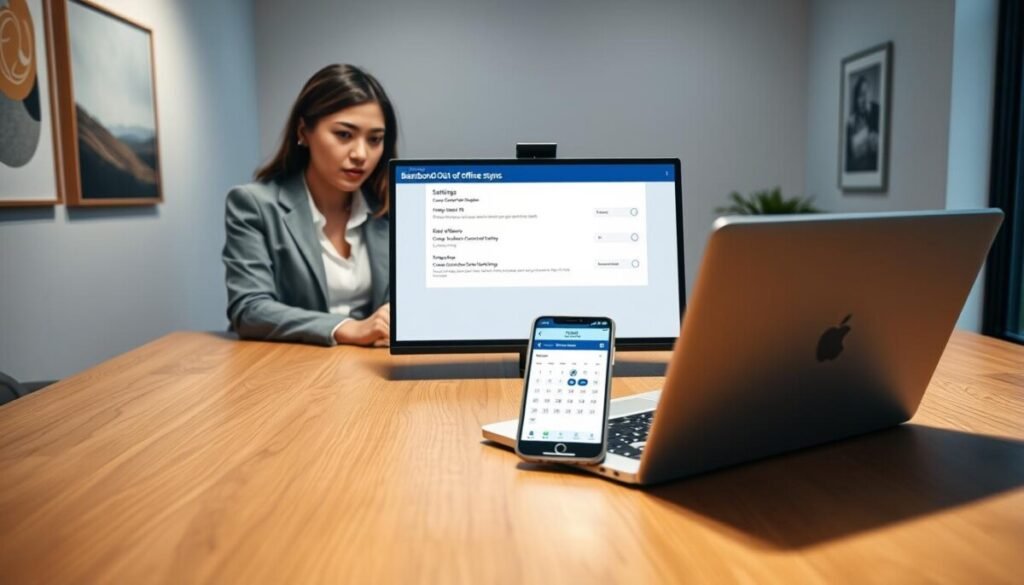
Start with a field inventory—label every data point that must replicate to calendar entries.
Mapping Data Fields
Map each field from HR records to the matching calendar fields. Document source names and target names. Create a single mapping sheet for audit and rollback.
When mapping, make sure payroll-related fields are flagged. Flagging prevents payroll mismatches and maintains clean data records. Define validation rules for dates, durations, and status codes.
Connecting Your Calendar System
Configure the integration connector. Assign user credentials and grant least-privilege access. Set the update cadence—choose near-real-time for critical calendars or scheduled batches for lower load.
Use platforms like Integrately; the platform supports 2,000 tasks for $19.99 and can handle bulk requests and mapped changes. Test with a small user set. Verify that each field transforms into the expected calendar content.
Checklist
- Confirm all mapping fields match company policy.
- Validate payroll fields against payroll system rules.
- Run sample requests and inspect resulting calendar records.
For detailed calendar setup guidance, follow this how to schedule office hours in guide to align availability rules with the integration process.
Managing Employee Time Off Requests and Calendar Visibility

Ensure each approved absence publishes precise calendar entries and status updates across tools.
Roots PTO lets every employee sync personal and team calendars with approved time entries. This provides company-wide visibility and reduces manual updates.
Automating Status Updates for Slack and Outlook
Configure the Slack and Outlook integration to push status changes when a request is approved. Automate presence updates so a user signals absence to their manager without manual steps.
Make sure the status field maps to the correct time range. Validate the field that holds start and end times. Validate the data payload for every request.
- Roots PTO enables users to sync calendar events for clarity across teams.
- Automated Slack status via Outlook reduces handoffs for the user and manager.
- Managers monitor team availability through calendar data that updates with each request.
For tracking best practices, reference the employee time-off tracking guide to align policies and automation.
Streamlining Your HR Workflow for Better Team Coordination
Reduce administrative load by automating absence records and enforcing consistent field definitions.
Optimize the HR process to save manager time. Automate routine requests so managers focus on strategic work rather than record keeping.
Ensure the integration writes precise calendar entries and standardizes each field. This reduces questions from users and keeps company information current. Reference integration tutorials for setup: integration tutorials.
Maintain payroll accuracy with a fixed field structure. Automate updates so employees view real-time calendar content. Validate changes to the system to preserve records and minimize disruption.