65% of professionals admit they lose work hours to poorly timed messages. This single metric reveals the scale of a solvable productivity leak. Implement a controlled delay for outgoing mail to ensure timing aligns with recipient patterns and deadlines.
Enable the native delay feature to hold a message until the exact delivery time. Access options via the ribbon or the dropdown menus—desktop and web versions both provide this capability.
Use this method to manage communication flow, prevent interruptions, and preserve focus during peak work periods. Apply the option to target recipient availability, subject relevance, and account policies.
Result: Professional timing control—improved response rates and fewer missed deadlines. This section outlines the conceptual value and where to find the controls in each version of the client.
Key Takeaways
- Enable delayed delivery to control when an email reaches the recipient.
- Access scheduling options from the ribbon or dropdown across desktop and web versions.
- Use timed delivery to reduce interruptions and improve focus during work blocks.
- Timing control supports better professional communication and deadline adherence.
- Apply consistent timing rules to boost productivity and work-life balance.
Understanding the Benefits of Scheduled Email Delivery
Timed delivery aligns message dispatch with recipient work patterns to boost response rates. Use the feature to respect off-hours and reduce unnecessary interruptions.
Delay delivery prevents messages from sinking to the bottom during peak traffic. This preserves visibility and increases the chance of timely engagement.
Apply scheduling emails to match recipient active times across time zones. Doing so improves professional perception and supports work-life balance. As you schedule emails for peak engagement, consider using analytics tools to determine the best times to reach your audience. This approach not only enhances open rates but also encourages timely responses, fostering better communication. Additionally, tailoring your messages based on recipient preferences can further boost engagement and strengthen professional relationships.
- Place messages during peak productivity windows—maximize opens and replies.
- Use the schedule emails outlook function to avoid weekend or late-night alerts.
- Consistent timing delivers predictable communication patterns—improve recipient trust.
| Benefit | Effect | When to Use |
|---|---|---|
| Respect off-hours | Higher goodwill | After-hours drafts |
| Avoid inbox crowding | Better visibility | High-traffic times |
| Time-zone alignment | Improved replies | Cross-border work |
For tactical guidance on related timing tools, review a compact schedule email outlook guide.
How to Use Outlook Schedule Send on Desktop
Control timed delivery from the desktop client to ensure messages reach recipients at optimal hours.
Classic Workflow
Compose the message. Open the Options tab. Locate Delivery options.
Check the “Do not deliver before” box. Set the date and time. Use this to implement delay delivery for a scheduled email.
- Verify subject line and recipients before finalizing.
- Keep the client online—the outbox holds the message until delivery.
New Interface
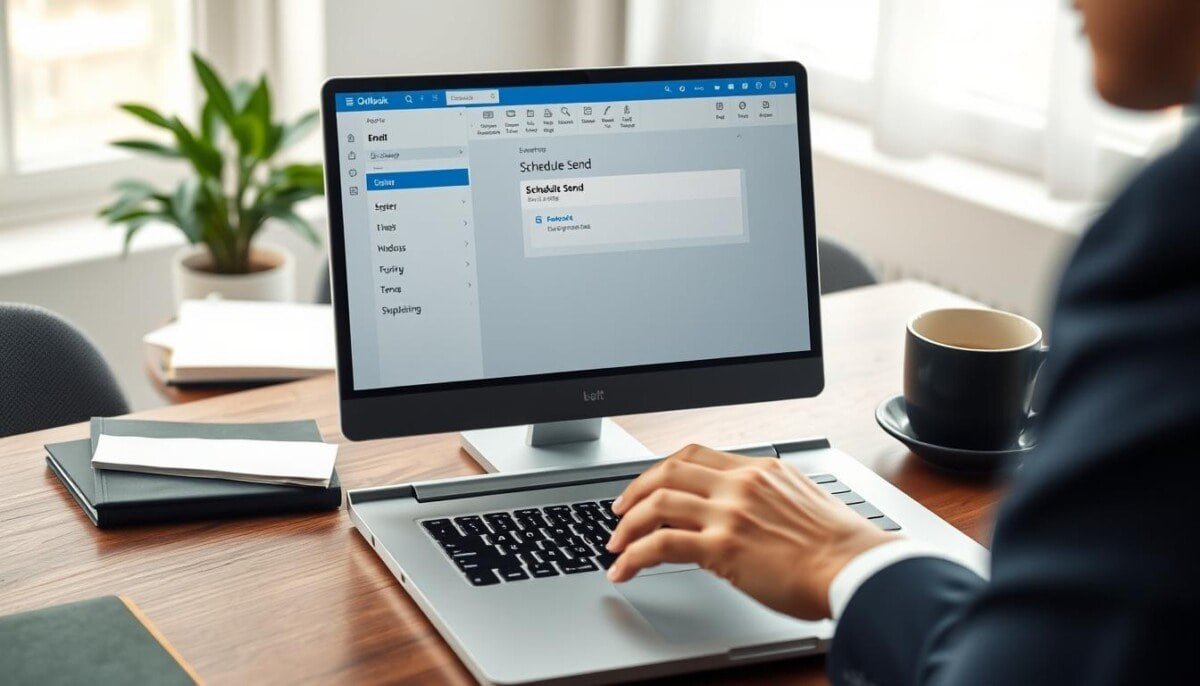
Compose email in the new app. Click the arrow next to the Send button. Choose Schedule send.
Items created by the new version appear in Drafts until dispatch. This simplifies scheduling emails outlook for quick edits.
| Action | Classic | New Interface |
|---|---|---|
| Set delivery time | Options → Delivery options → Do not deliver before | Send dropdown → Schedule send |
| Storage before delivery | Outbox folder — requires client online | Drafts — server-managed |
| Edit or cancel | Open Outbox item; modify or delete | Edit in Drafts; update schedule or discard |
Note: Confirm account connectivity and timing. Use precise subject lines to avoid miscommunication.
Scheduling Messages in the Web Version of Outlook
Compose the message. Click the down arrow beside the Send button. Choose a future delivery time from the menu.
Scheduled emails in the web version remain in the Drafts folder until the specified time. Edit or cancel any draft before dispatch. The web app enforces delivery on the server—no local client required.
Behavior is consistent across devices and operating systems. The interface mirrors desktop features; options appear in the same position. This reduces training friction for teams and supports remote workflows.
- Compose email content and confirm subject and recipients.
- Select the Send arrow; pick a date and time.
- Manage scheduled items from Drafts—modify or remove as needed.
For a related workflow on calendar office hours, reference the guide to schedule email outlook.
| Action | Location | Notes |
|---|---|---|
| Select delivery time | Send button arrow | Menu shows preset and custom options |
| Storage before delivery | Drafts folder | Server-managed—no client uptime required |
| Edit or cancel | Open Drafts item | Change time or delete before dispatch |
Managing Your Outbox and Drafts for Future Sends

Identify whether pending messages reside in Outbox or Drafts prior to any changes. Confirm storage location—Classic clients hold pending items in the Outbox. New clients and the web version store pending items in Drafts.
Editing or Canceling Scheduled Items
Open the folder that contains the pending emails outlook. Locate the item and open it for review.
Use the options menu to adjust the delivery time. Save changes to update the scheduled email.
To cancel scheduled delivery, delete the message from the folder. Deletion removes the pending message and prevents delivery.
- Verify subject and recipients before modifying any scheduled email.
- Check the folder regularly to prevent stale or incorrect messages.
- Maintain a clear folder structure to reduce accidental delays.
| Client Type | Pending Folder | Action to Edit |
|---|---|---|
| Classic desktop | Outbox | Open Outbox item → Options → Modify delivery time |
| New app / web | Drafts | Edit draft → Adjust time or delete to cancel scheduled email |
Utilizing Mobile Apps for On-the-Go Scheduling
Use the mobile app to queue messages for later delivery when desktop access is unavailable.
Procedure: Compose email content on the phone. Tap the three-dot menu or the arrow by the button. Choose the send later option to set date and time.
Android
Scheduling on Android
Open the mobile app. Compose email and tap the action menu. Select the send later option and pick a delivery time.
Pending items remain in Drafts until the chosen time. Edit or delete the draft to cancel scheduled delivery.
iOS
Scheduling on iOS
Compose email. Tap the arrow or menu to reveal the send later feature. Set the time and confirm.
Drafts store scheduled emails. Remove the draft to cancel scheduled email delivery or modify the subject and time before dispatch.
- Keep the mobile app updated—features and options change with releases.
- Verify time zones when setting delivery time on the device.
Advanced Techniques for Recurring Email Automation
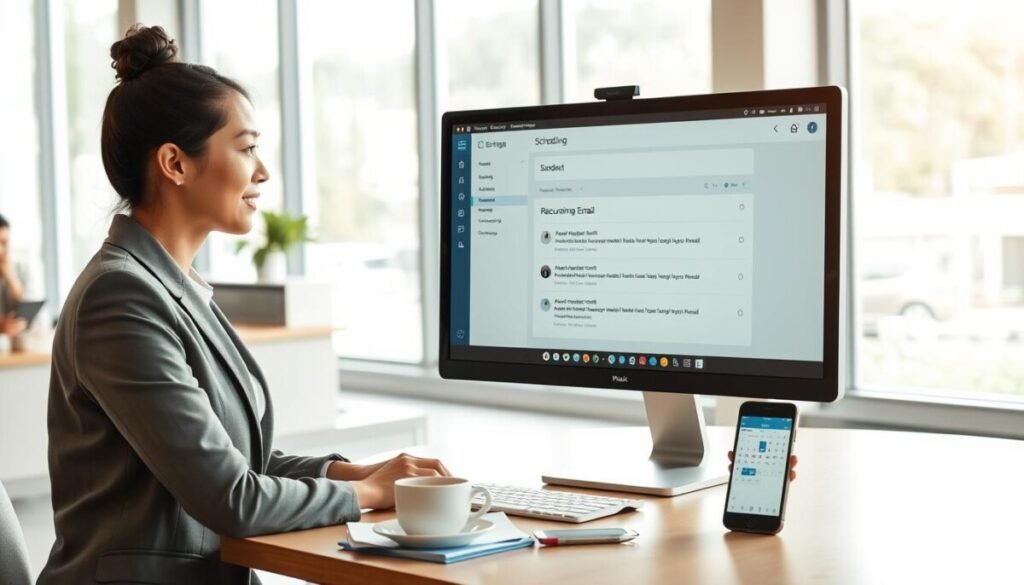
Implement a recurring task with an attached draft to automate periodic message reminders. Create the task with a repeating interval. Attach the prepared draft so the reminder opens ready content.
Procedure: Configure the task recurrence. Set the reminder time. Use the reminder to open, verify, and send the draft.
While the client lacks native recurring-email automation, this method creates a reliable loop for weekly reports and team updates. Attach notes to the task to document recipients and context.
- Create a recurring task—set interval and reminder.
- Attach the draft email to the task—open it when notified.
- Use consistent naming to find drafts quickly and avoid errors.
- Combine with third-party tools for greater automation and fewer manual steps.
For a focused walkthrough on recurring workflows, review the recurring email in Outlook guide. For auxiliary timing tools, consult the schedule text guide.
Troubleshooting Common Delivery Failures
Verify recipient local time before finalizing a future delivery to prevent unexpected arrival hours.
Addressing time zone discrepancies
Confirm sender and recipient clocks. Compare device time, account time zone, and recipient location.
Time mismatches cause scheduled emails to land at odd hours. Correct the client time settings before finalizing the schedule send.
Quick diagnostic checklist
- Make sure internet connection is stable at the scheduled delivery time.
- Check Sent Items for error notifications if a scheduled email fails to arrive.
- Verify whether the pending item resides in Drafts or the Outbox folder before altering options.
- Cancel scheduled delivery when timing was miscalculated—delete the pending draft or outbox item to stop dispatch.
- Monitor server status and retry if network or server errors caused a delivery failure.
For protocol-level troubleshooting, consult the delay delivery troubleshooting guide to resolve persistent failures and confirm delivery logs.
Best Practices for Professional Email Timing
Prioritize delivery during high-attention periods—morning startup or post-lunch focus blocks. Target the start of the workday or just after lunch for optimal engagement. Avoid weekend and holiday dispatch unless required by the recipient role.
Make sure that messages reach the recipient during active work hours. Use the delay delivery option to align arrival with these windows. This improves reply rates and reduces perceived intrusion. For times when focus is crucial, you can set up do not disturb mode on your devices to minimize distractions. This allows for deeper concentration on tasks without the worry of notifications interrupting your workflow. By ensuring that only urgent communications break through, you can maintain a more productive environment.
Apply simple management rules. Draft outside core hours. Queue items for morning or after-lunch delivery. Do not place routine messages on weekends.
- Prefer morning or post-lunch times for important email.
- Avoid weekend or holiday deliveries to respect work-life boundaries.
- Use scheduling emails tools to control timing and maintain professionalism.
- Review recipient time zone before finalizing a scheduled message.
Result: Consistent timing signals reliability. Proper timing management demonstrates respect for recipient time and boosts the effectiveness of every email.
Integrating Third-Party Tools for Enhanced Functionality
Add third-party extensions to expand delivery controls and automate follow-ups.
Integrate Boomerang to gain natural-language timing, offline queuing, and recurring email capabilities not native to the client. Boomerang enables users to create a scheduled email using plain phrases—then convert that intent into a precise delivery time.
Benefits:
- Natural language scheduling for fast setup.
- Offline composition with guaranteed timed delivery when the account reconnects.
- Recurring messages and read receipts—features absent in core feature sets.
Comparing native features
Native tools provide basic delay delivery and drafts management. Third-party tools extend follow-up automation and analytics. Confirm version outlook compatibility before installing any add-on.
| Capability | Native Client | Boomerang (third-party) |
|---|---|---|
| Set delivery time | Options → Do not deliver before / Send dropdown | Natural language entry; quick presets |
| Offline queuing | Limited—depends on client and folder | Full offline scheduling; sends when online |
| Recurring emails | Workarounds via tasks or manual repeats | Built-in recurring message automation |
| Read receipts & follow-ups | Basic tracking; limited automation | Advanced read receipts; auto reminders |
Install only verified extensions. Verify account permissions, version compatibility, and web or mobile feature parity. Use third-party tools to augment productivity—not to replace core delivery controls.
Security Considerations for Delayed Messages
Treat delayed messages as active drafts—review security settings before delivery.
Make sure that every queued email uses appropriate protection when it contains sensitive data.
When using delay delivery, enable built-in encryption for confidential files. Verify attachment permissions and remove any unnecessary documents.
- Double-check the recipient list—confirm names and distribution groups.
- Confirm attachments—scan files and remove editable copies if not required.
- Apply message encryption and rights management when needed.
The time between composition and delivery is an opportunity. Use it to run a final security check. Cancel or edit the draft if anything is incorrect.
Result: Secure emails outlook protect data and preserve professional trust. Maintain the same caution for scheduled emails as for immediate delivery.
| Risk | Mitigation | Action Window |
|---|---|---|
| Wrong recipient | Verify addresses; use distribution group checks | Before final delivery time |
| Unsecured attachment | Encrypt file; convert to PDF or remove sensitive data | During draft review |
| Unauthorized access | Apply rights management; restrict forwarding | When queuing the message |
For procedural guidance on timed communications in other platforms, consult this brief guide on how to schedule text on iMessage.
Mastering Your Inbox Workflow for Better Productivity
Centralize message preparation into focused intervals. Use the schedule send option to batch-compose and assign delivery windows. Queue items as drafts and use the send later feature to align delivery with attention peaks.
Adopt a repeatable process. Use schedule emails outlook tools once per work block. Confirm recipients, attachments, and delivery options before committing a scheduled email. In addition, consider using snooze emails in Microsoft Outlook to temporarily defer messages that require your attention later. This feature can help manage your inbox more effectively and minimize distractions during focused work periods. By utilizing these tools, you can maintain better control over your email flow and enhance your productivity.
Retain the ability to cancel scheduled delivery. Edit or delete pending items from the drafts or outbox folder to prevent mistakes. Repeat this routine daily—measure time saved and adjust blocks for better management.