Have you ever wondered which software model is better for your business: the convenience of cloud-based solutions or the flexibility of customizable platforms? In today’s fast-paced digital world, making the right choice is crucial for our success.
As we explore the fundamental differences between these two approaches, we aim to help our team make an informed decision. The global market for cloud services is booming, with projections indicating a staggering value of $247 billion by 2026. This growth highlights the increasing adoption of innovative solutions that can drive operational efficiency.
Our goal is to navigate the complexities of selecting the right software for our needs. We want to ensure that the tools we choose align perfectly with our requirements for performance, security, and future growth. By analyzing both options, we can better understand which path offers the best value for our unique organizational needs.
Key Takeaways
- Understanding the differences between software models is essential for informed decision-making.
- The SaaS market is rapidly growing, emphasizing the need for effective cloud solutions.
- Choosing the right software impacts long-term operational efficiency.
- Flexibility and customization are key advantages of certain platforms.
- Aligning software choices with business goals is crucial for success.
Understanding the Landscape of Software Solutions
Exploring the nuances of software solutions is vital for making informed business decisions. Two primary models dominate the landscape: open source and software-as-a-service (SaaS). Each offers unique benefits and challenges that we must consider.
Defining SaaS and Open Source
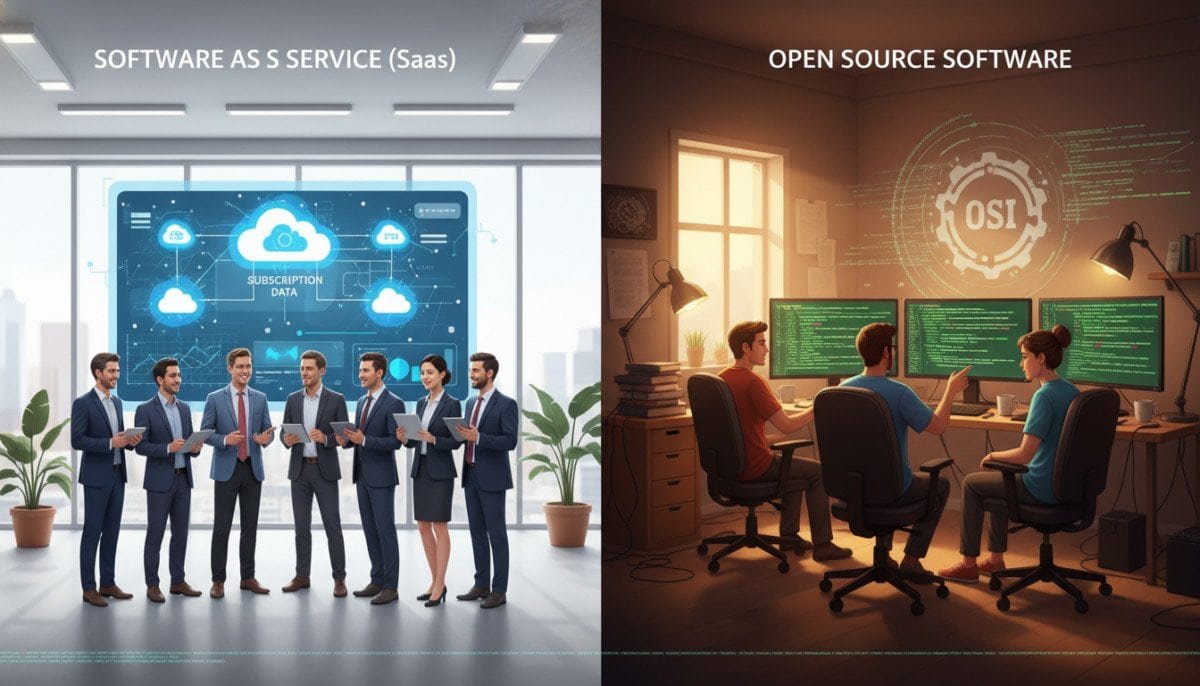
Open source software allows us full access to the source code. This means our team can edit and adapt it to meet specific needs. In contrast, SaaS platforms operate on a subscription model. Here, the provider manages backend operations, hosting, and maintenance for our business.
The Business Context and Our Approach
We recognize that open source solutions offer a blank canvas for our developers. Meanwhile, SaaS platforms provide a more turnkey, ready-to-use experience. Understanding how these platforms impact our daily operations is essential for our ability to innovate quickly.
Our approach involves weighing the benefits of complete control against the convenience of having a dedicated provider handle technical tasks. We must determine if our internal resources are better spent on managing open source infrastructure or focusing on our core business objectives.
Evaluating the Benefits and Drawbacks for Our Business

Selecting the right software solution can significantly impact our operational efficiency. As we delve into the advantages and disadvantages of various platforms, it’s crucial to weigh our options carefully.
On one hand, open source solutions provide remarkable flexibility and customization. This allows us to tailor our ecommerce platforms to meet our specific needs. However, we must also consider the hidden costs associated with developer time and ongoing maintenance.
Conversely, SaaS platforms offer a turnkey simplicity that can be appealing. Yet, we need to be cautious about how subscription costs can accumulate as our business scales. Evaluating whether the long-term investment in open source is justified by the control we gain over our digital storefront is essential.
| Factor | Open Source | SaaS |
|---|---|---|
| Initial Costs | Lower upfront costs, but hidden expenses | Higher upfront subscription fees |
| Customization | Highly customizable | Limited customization options |
| Maintenance | Requires dedicated resources | Provider handles maintenance |
| Scalability | Can be complex | Easy to scale with subscription |
Ultimately, balancing the need for rapid deployment with the desire for deep customization is a critical challenge for our ecommerce strategy. For more insights on this topic, check out our detailed comparison here.
Exploring saas vs open source for Business Needs

Understanding how different software models fit our business needs is crucial for our success. Each option presents unique advantages and challenges that we must consider carefully.
Cost Considerations and Subscription Models
We have observed that open source recruitment platforms may present a more cost-effective alternative for organizations requiring more than 10-20 users. This flexibility can lead to significant savings in the long run.
On the other hand, SaaS platforms simplify our operations by handling maintenance and support. This allows our team to focus on hiring rather than managing infrastructure, which can be a major time-saver.
When comparing subscription models, we must consider that SaaS platforms often have lower initial costs but higher long-term recurring fees. Our business needs dictate whether we prioritize the hands-off approach of a SaaS provider or the granular control of an open source solution.
Maintenance, Support, and Vendor Responsibilities
We are analyzing how different platforms manage updates and security patches. This ensures our data remains protected without constant manual intervention. Choosing between these models requires us to be honest about our technical capacity and our willingness to manage complex software environments.
For further insights on software pricing, check out our detailed comparison here.
Security and Compliance: Balancing Control and Risk
In today’s digital landscape, security and compliance are paramount for our software choices. We need to evaluate how different models handle these critical aspects.
With an open source solution, we take on the full responsibility of maintaining security patches and meeting strict PCI compliance standards. This requires significant time and expertise from our internal IT team.
On the other hand, SaaS platforms simplify our security posture. The provider manages updates and protects our site against common vulnerabilities automatically. This convenience allows us to focus on our core business activities.
To ensure robust protection, we must select reliable tools and maintain a strong security firewall. We are weighing the risk of potential security vulnerabilities in open source against the convenience of a managed security model.
Ultimately, compliance is a non-negotiable aspect of our business. We need a solution that keeps our data safe at all times.
Customization and Scalability: Tailoring Solutions to Our Growth

As we navigate the world of software solutions, understanding customization and scalability is essential for our growth. Each model presents unique opportunities that can align with our business objectives.
Open source customization allows us to modify the source code to create a unique experience tailored to our specific requirements. According to a 2020 Statista survey, 65% of tech-focused companies preferred open source to avoid being locked into a single provider. This flexibility can lead to innovative solutions that set us apart from competitors.
Opportunities with Open Source Customization
With open source, we can leverage widely-used programming languages for infinite scalability. This adaptability is vital for our evolving needs. However, we must balance the power of customization against the complexity it introduces to our system updates and maintenance.
Scalability on SaaS Platforms
While SaaS platforms offer scalability, we need to be aware of the limitations imposed by the provider’s infrastructure and proprietary code. Ensuring that our chosen solution has the necessary resources to grow with us is crucial. Whether we opt for the infinite scalability of open source or the managed growth of SaaS, our growth strategy depends on having a platform that adapts to our changing needs.
| Factor | Open Source | SaaS |
|---|---|---|
| Customization | Full access to modify code | Limited customization options |
| Scalability | Infinite scalability potential | Scalability depends on provider |
| Flexibility | Highly flexible for changes | Less flexible due to constraints |
| Resource Requirements | Requires dedicated resources | Managed by the provider |
In conclusion, understanding the nuances of customization and scalability will help us choose the right software solutions. For more insights on this topic, check out our detailed comparison here.
Performance and Infrastructure: Hosting, Updates, and Speed
The performance of our software solutions directly impacts our business efficiency. This includes how we manage hosting, updates, and overall speed. When we choose a platform, we must consider these factors carefully.
SaaS platforms handle all the heavy lifting regarding hosting, server updates, and performance optimizations like CDNs and caching. This ensures our site remains fast for customers, especially during peak times.
On the other hand, with open source, we are responsible for managing our own infrastructure. This includes setting up CDNs, load balancers, and manually tuning the database. We must decide if our team has the time and expertise to manage server loads or if we prefer the auto-scaling benefits of SaaS.
Performance is critical to our operations. We cannot afford to have our site buckle during high-traffic events like Black Friday. Evaluating the total cost of ownership, including the time spent on manual software updates and infrastructure management for open source, is essential.
Ultimately, our goal is to maintain a high-speed experience for our users, regardless of whether we choose a managed or self-hosted solution. For further insights on this topic, check out our detailed comparison here.
Real-World Examples and Comparative Case Studies
Examining real-world examples can provide valuable insights into our software choices. By looking at successful implementations, we can understand how different platforms serve various business needs.
Ecommerce Platforms
We explore platforms like Shopify and BigCommerce, which offer robust SaaS tools for brands ready to scale their operations. These platforms simplify ecommerce management, allowing us to focus on growth.
In contrast, Magento remains a powerful open source option. It caters to large, complex ecommerce operations that require deep customization and full control over the code.
Recruitment Solutions
For recruitment, we find open source tools like JazzHR and Recruitee. These tools offer collaborative development and transparency, making them ideal for our hiring team.
SaaS PIM solutions such as Catsy, Plytix, and Salsify help us centralize product data across multiple sales channels. These platforms often charge a monthly fee, which we need to consider in our budget.
Our case studies show that while open source requires more developer time, it avoids vendor lock-in associated with some SaaS options. We must also evaluate the total cost of ownership, including any paid plugins and support contracts.
By reviewing these options, we can better understand which platform aligns with our current technical resources and long-term business goals. For more insights on ecommerce platforms, check out our detailed comparison here.
Final Thoughts on Choosing the Right Software Solution
Choosing between different software models is critical for our organization’s growth and success. We understand that SaaS offers a convenient, subscription-based approach, perfect for teams that prefer to avoid complex infrastructure management.
On the other hand, open source remains the best choice for those needing full control and deep customization. Our final decision will depend on our internal capacity for maintenance, security requirements, and the need for rapid scalability.
Ultimately, we are committed to selecting a platform that allows us to focus on our core business, rather than spending excessive time managing our software stack. For further insights, check out our detailed comparison of options here.