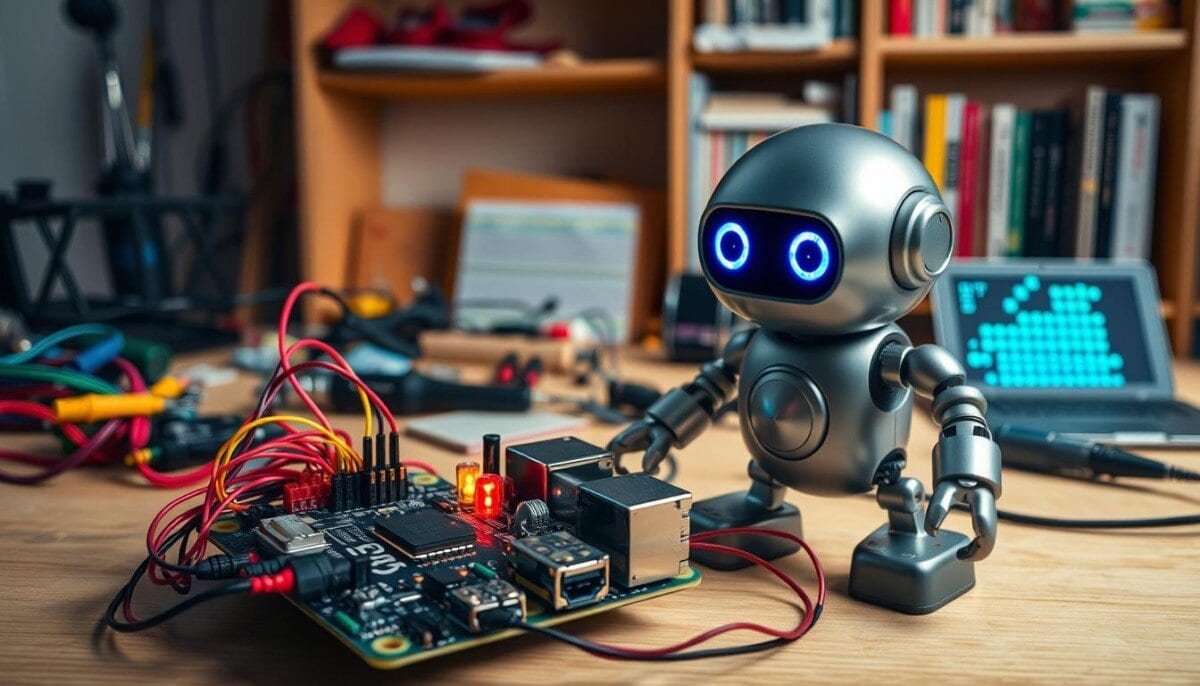
Have we really built a self-driving lab using a tiny board and modern AI, , that can collect and analyze data on its own?
In this article we explain how we used a Raspberry Pi 4 to connect to Claude and create a functional system. We set a clear goal: build a robust, automated platform for data collection and analysis.
We will guide you through hardware setup, software configuration, and practical tips to keep development smooth. Our aim was to make a versatile base that supports many experiments and grows with our needs.
Join us as we document our journey, share failures and wins, and refine our technical skills. We hope this project inspires you to try your own experiments and expand what is possible at home or in the lab.
Key Takeaways
- We used a compact board and an AI assistant to automate data tasks.
- The core goal was a reliable, extendable project platform.
- Step-by-step setup covers both hardware and software needs.
- We prioritized reproducible data collection and analysis.
- Our journey aims to help others replicate and expand the idea.
Getting Started with Raspberry Pi with Claude
The opening move was to set up a stable environment that lets hardware talk to an AI server.
Understand the bridge: getting this machine running means we must connect sensors, drivers, and networked agents. A clear plan reduces surprises and keeps things manageable.
We made the board act as an assistant that gathers data and calls the Claude-Light endpoint at https://claude-light.cheme.cmu.edu/gm for experiments. Start small, test each sensor, and verify network calls before scaling up.
Many things can fail during setup, so we recommend a methodical approach. Boot the OS, enable interfaces, and confirm serial or GPIO connections one at a time.
Finally, focus on simple coding to create a repeatable interface. We outline how to log data, trigger experiments, and manage results. For guidance on building connected tools and interfaces, see our guide to build online tools.
Selecting the Right Hardware Components
Choosing the right hardware set the foundation for every test and result in our lab.
We picked a single core model that balanced memory and I/O. The recommended machine for this build was the Raspberry Pi 4 (8GB). That choice kept our code compatible with sensor libraries and sped up AI-driven tasks.
Essential Hardware Parts
- Core board: Raspberry Pi 4 (8GB) for processing and network tasks.
- Extender: Tall 40-pin extender to clear components on the prototype board.
- Power and storage: Reliable supply and a fast microSD or SSD for stable work.
Camera and Sensor Integration
We used the AS7341 color sensor for precise light readings. This small part gave repeatable spectral data that improved experiment quality.
For visual feedback we integrated an Arducam Motorized Focus Pi Camera. This thing allowed remote focus control and better image capture during runs.
| Component | Purpose | Notes |
|---|---|---|
| Raspberry Pi 4 (8GB) | Core processing | Compatible with common libraries for coding |
| AS7341 color sensor | Light measurement | High precision for spectral readings |
| Arducam Motorized Focus | Visual capture | Motorized focus for dynamic imaging |
| 40-pin extender | Physical clearance | Ensures all parts fit on prototype board |
Preparing the Operating System for AI Tasks
We started by updating the OS and enabling key interfaces to make development smoother.
Proper preparation meant a short checklist and steady execution. First, we ran the package refresh and cleanup to ensure libraries were current:
sudo apt update && sudo apt full-upgrade && sudo apt clean
Next, we enabled the I2C interface and SSH for remote access using raspi-config. Enabling these two items was a small part of setup, but it saved a lot of time later.
Enabling Interfaces
Enable I2C to let sensors speak over the bus. Enable SSH so we can log in remotely for long runs.
- Use raspi-config to activate I2C and SSH.
- Reboot after changes to make sure modules load correctly.
- Confirm devices appear with i2cdetect and test network connectivity.
We preferred the latest OS model that matched our libraries. This reduces package conflicts and keeps coding focused on experiments rather than system fixes.
| Step | Command / Action | Why it matters |
|---|---|---|
| System update | sudo apt update && sudo apt full-upgrade && sudo apt clean | Keeps packages current and avoids version conflicts |
| Enable I2C | raspi-config → Interface Options → I2C | Allows sensor communication over the bus |
| Enable SSH | raspi-config → Interface Options → SSH | Remote management for long experiments |
Installing the Claude Environment
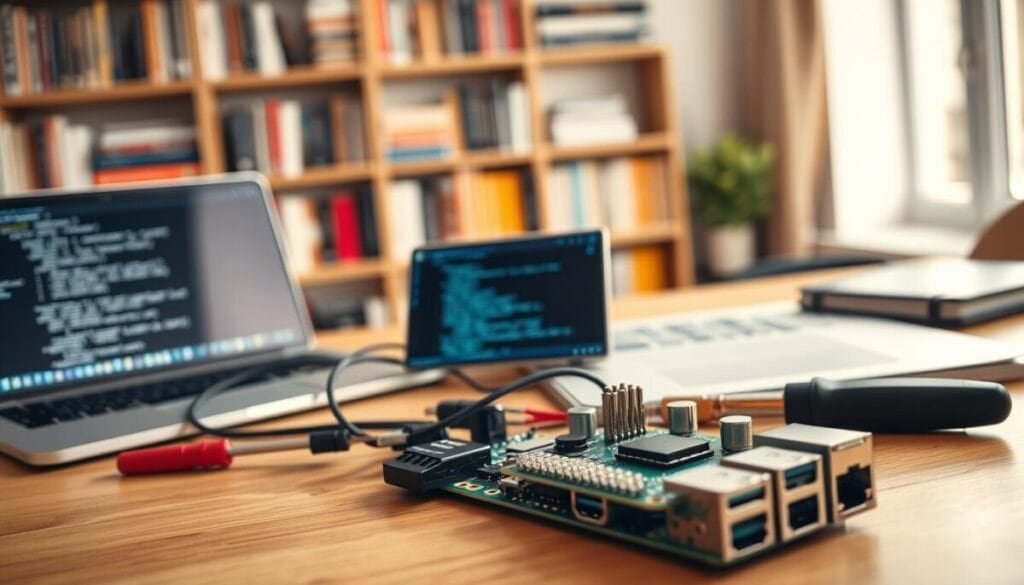
To run experiments reliably, we isolated dependencies inside a fresh virtual environment.
Begin by creating the venv in your project folder. In the terminal we used:
python -m venv –system-site-packages .venv
This keeps system files separate and makes upgrades safer.
We install a small app that talks to the Claude-Light server. Clone the repository to your workspace as an easy example and follow its README for required packages.
Keep the system prompt concise — under 1,000 tokens — so the model retains enough context for complex tasks. This also speeds interactions and reduces unexpected behavior.
- Organize: one venv per project to avoid dependency conflicts.
- Test: run small code snippets before launching long experiments.
- Harness: a dedicated coding harness gives us clear control over inputs and outputs.
| Step | Command | Why |
|---|---|---|
| Create env | python -m venv –system-site-packages .venv | Isolates dependencies |
| Clone repo | git clone <repo-url> | Example install and docs |
| Run tests | ./run-tests.sh | Validate the app and code paths |
Configuring Systemd for Automated Services
We automated service startup so our experiment server boots and runs without manual steps. This step made our long runs more reliable and reduced downtime.
Creating the Service File
We created a dedicated file at /etc/systemd/system/claude.service that defines how the server runs. The unit included the user, working directory, exec command, and a restart policy.
Example entries we used: User=, WorkingDirectory=, ExecStart=, and Restart=on-failure. These fields helped the system manage permissions and recovery.
Managing Service Status
Configuring systemd became a key part of our coding workflow. We enabled persistence so services start after reboots using:
- sudo systemctl enable claude.service — persist across reboots
- sudo systemctl start|stop|restart claude.service — control runtime state
- sudo journalctl -u claude.service -f — tail logs for debugging
Managing status is simple and keeps our background work predictable. This automation streamlined our lab tasks and improved overall workflow.
| Action | Command | Why |
|---|---|---|
| Create service | sudo nano /etc/systemd/system/claude.service | Defines how the server starts and restarts |
| Enable on boot | sudo systemctl enable claude.service | Makes the service persistent across reboots |
| Monitor | sudo journalctl -u claude.service -f | View logs to confirm stable operation |
Optimizing Display and Input Settings
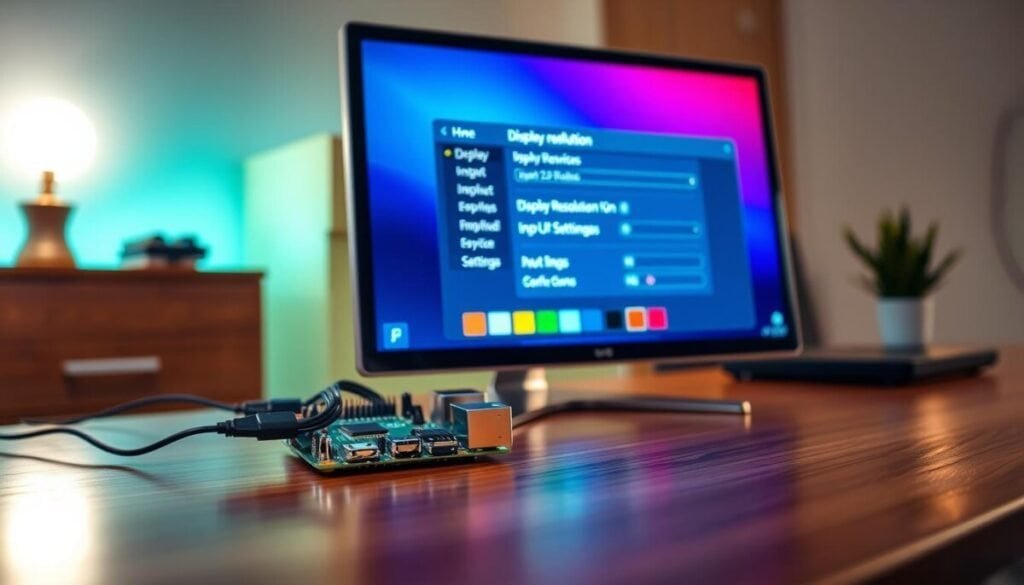
We tuned the desktop and input stack to make every interaction feel instant and reliable.
One thing that improved the user experience was lowering input latency. We edited the file at /boot/firmware/cmdline.txt and added usbhid.mousepoll=1. That change set USB polling to 1000Hz and reduced cursor lag on our mouse.
For Wayland systems we used wlr-randr to set display resolution. This utility let us match the monitor’s native resolution and scale the desktop correctly. The result was crisper text and fewer redraw artifacts during coding sessions.
- Set USB polling to 1000Hz to cut input delay.
- Use wlr-randr to set resolution and refresh rate precisely.
- Document every config change so settings persist across reboots.
| Setting | How to apply | Benefit |
|---|---|---|
| USB polling | Edit /boot/firmware/cmdline.txt — add usbhid.mousepoll=1 | Lower input latency, smoother cursor |
| Display resolution | Run wlr-randr –output NAME –mode WIDTHxHEIGHT | Correct scaling, reduced distortion |
| Config tracking | Keep a changelog in the project repo | Consistent settings after reboots |
Enhancing Security with Firewall Protocols
We locked down our network early to keep experiments safe and reduce attack surface. A simple firewall and a few automated tools gave us a reliable baseline for remote work.
Install ufw and allow SSH only on port 22/tcp. This lets us access the machine securely while blocking other inbound traffic. We also documented the rule set in our repo so changes track over time.
Automating Security Updates
We enabled unattended-upgrades to keep the system current. This reduced manual maintenance and helped close vulnerabilities faster than weekly checks.
- Install and enable ufw; allow 22/tcp for SSH.
- Configure unattended-upgrades to apply security patches automatically.
- Monitor logs at /var/log/unattended-upgrades/ to confirm successful runs.
- Track SSL expiry—our certificate expires on 2024-12-14—and renew before that date.
| Item | Action | Why it matters |
|---|---|---|
| ufw | sudo apt install ufw; sudo ufw allow 22/tcp; sudo ufw enable | Limits inbound connections to essentials |
| unattended-upgrades | apt install unattended-upgrades; dpkg-reconfigure | Applies security patches automatically |
| SSL monitoring | Log expiry and set reminders | Prevents unexpected downtime at certificate expiration |
Exploring Practical Experiments and Data Analysis
We designed a set of small experiments that show how measured light levels map to repeatable outcomes.
Reproducibility and Statistics
We ran controlled trials that measured the 515nm light level across a range of inputs. Each run included repeated samples, time stamps, and basic error estimates. This lets us check that results are stable and comparable.
Linear Regression Modeling
As a key part of our workflow, we used multivariate linear regression to build a predictive model for input and output data. The regression helped reveal which factors most affect the 515nm reading and improved our uncertainty estimates.
API Scripting Examples
We provide a short Python example that loops over input values. That script posts measurements to an endpoint, collects responses, and saves results for analysis. The simple code shows how to automate runs and refine the model.
Our project drew inspiration from Baird and Sparks (2022), who outlined minimal working examples for self-driving labs. By analyzing the collected data we improved our coding approach and tightened the experiment design.
| Part | Action | Outcome |
|---|---|---|
| Data collection | Looped measurements at varying input levels | Consistent 515nm readings with repeatability |
| Modeling | Multivariate linear regression | Predictive fits and factor ranking |
| Automation | API script example to run batches | Faster runs, reproducible logs |
Troubleshooting Common Deployment Hurdles
When deployments fail, our first move is to open a terminal and trace the error logs. This gives us immediate clues and saves wasted time.
One clear example: the installer repeatedly failed to find a required file. That error pointed at a mismatch in system layers. We discovered a 64-bit kernel running a 32-bit userspace. The installer could not complete under those conditions.
Re-imaging the SSD with a clean image resolved the conflict. It took about 20 minutes to re-image using the official imager. That reset fixed missing dependencies and allowed the installer to run.
We also leaned on our coding assistant to validate commands and suggested fixes. That shortcut helped us identify a bad configuration and restore the machine to a working state.
- Spend focused time in the terminal to collect logs and stack traces.
- Verify kernel and userspace bitness before running installers.
- When an installer cannot find a file, a fresh image is a fast remedy.
- Keep a clean environment to deploy models and tools reliably.
Below is a quick comparison of actions and their outcomes to help guide fixes.
| Issue | Action | Result |
|---|---|---|
| Installer missing file | Re-image SSD | Resolved dependencies; installer completed |
| Kernel/userspace mismatch | Confirm bitness; reflash correct image | Installer compatibility restored |
| Unexpected machine behavior | Use terminal logs and a coding assistant | Configuration error found and fixed |
For a helpful example of starting to start coding on Linux, follow that link. It fits well with our practical troubleshooting steps and saves us more time during future deployments.
Expanding the Potential of Our AI-Driven Projects
In this article we summarized how to build and maintain a self-driving laboratory as a practical project that scales. We focused on reliable automation, clear data logging, and reproducible experiments.
Bringing together low-cost hardware and an AI assistant unlocked new ways to run experiments. Our assistant sped routine tasks and kept long runs stable so we could focus on analysis and improvement.
There are many things to add next, such as computer vision or secure remote access. These extensions turn a single setup into an adaptable app or larger work stream that supports more complex goals.
Keep exploring: use these foundations to try new ideas, share results, and build richer systems for research and learning.