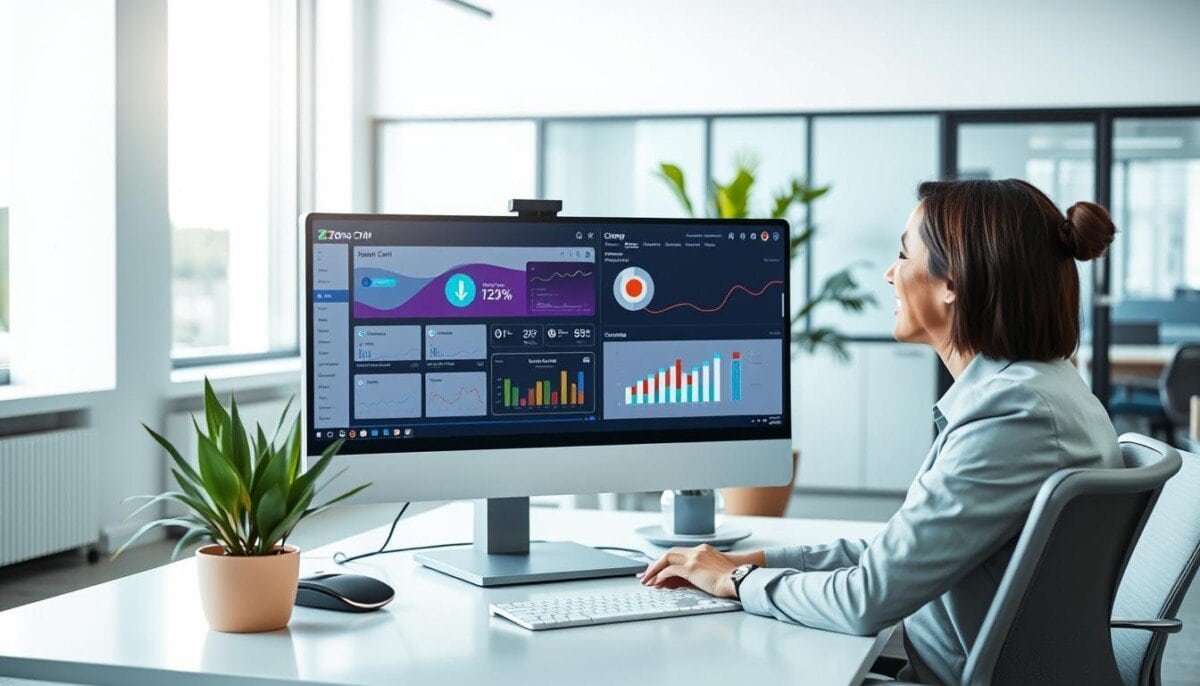
We asked ourselves a simple question: can a smarter system make our work faster and clearer? We wanted tools that turn raw numbers into clear next steps.
So we chose to adopt zoho crm with claude because it helps our team synthesize complex business data into actionable insights instantly.
By using this combined approach, we reduce manual entry and free our people to focus on growth. We also rely on real-time analytics and automation to stay responsive in the fast-paced United States market.
Our goal is practical: keep processes connected, make decisions quickly, and use every piece of information to move forward. For an overview of similar tools and real metrics, see this guide on customer relationship management tools.
Key Takeaways
- We pick tools that convert information into clear actions fast.
- Automation cuts manual entry and boosts team focus.
- Real-time insights help us react to market shifts quickly.
- Seamless connectivity keeps our internal workflows efficient.
- Choosing intelligent platforms supports sustained growth in the U.S.
Why We Integrated Zoho CRM with Claude
Connecting our tools let us turn scattered data into clear, fast action. We wanted a practical way to keep customer information synchronized and useful across teams.
Adzviser gives us superior support, so technical issues rarely interrupt workflows. That strong support reduces downtime and keeps our team moving.
We use the n8n platform as a reliable way to connect zoho crm and AI models. This approach removes a lot of manual work and makes automation the main way we process marketing data.
Our mix of integrations keeps data flowing between apps. The integration scales as we grow and stays cost effective.
- Adzviser support leads to faster issue resolution.
- n8n helps us connect zoho crm to AI without heavy coding.
- Multiple integrations keep customer records aligned across apps.
For an overview of similar solutions and practical metrics, see this guide on customer relationship management tools.
Understanding the Role of Model Context Protocol
We framed a standard that lets AI agents access business records safely and predictably.
Defining the Protocol
The Model Context Protocol is a clear, shared way for agents to reach structured data across our systems.
It turns regular apps into agent-ready tools so the system can read, write, and update records like a teammate.
How Agents Interact with Data
Our agents call specific endpoints and tools to perform tasks in real time.
They can create a new lead, update contact details, or trigger other actions across multiple apps.
- The protocol is the foundational way agents access structured data for daily tasks.
- By standardizing interactions, we cut manual steps and speed decision-making.
- Managers get accurate, up-to-date insight into the work flow and outcomes.
As implementation grows, our approach makes processes more autonomous and efficient. For automation best practices, see this LinkedIn automation guide.
Setting Up Your First Automated Workflow

We begin every automation by mapping a single repeatable task into a chain of actions. This keeps the setup small and clear so we can test quickly.
In n8n we create a new workflow and add a trigger—an app event, a schedule, or a webhook call—that starts the flow. From there we attach nodes that perform the needed actions across our apps.
Choosing Between Cloud and Self-Hosted Options
We pick n8n Cloud when we want a hosted, low-maintenance option. It speeds deployment and reduces infrastructure work.
We choose self-hosting when security and control matter most. That helps us connect zoho crm to our AI tools under strict policies.
- We configure a trigger in n8n to initiate each workflow automatically.
- Choosing cloud or self-hosted lets us balance security and speed for integrations.
- Automated workflows free our team from repetitive tasks and keep the platform tidy.
- Our integrations let agents perform complex actions across business apps.
- By automating data flow, we cut manual entry and focus on strategy using better tools.
Enhancing Data Analysis and Sales Performance

Our team moved from waiting on reports to acting on instant signals.
Hardik Dedhia from AllHome.in reported that MCP agents shifted his group from static dashboards to real-time AI-driven insights. We now use those insights to analyze sales performance and track deals more precisely.
By setting a trigger for our data analysis workflows, we push timely updates about customer behavior to the right people. That real-time flow helps us spot new opportunities faster.
Agents handle lead qualification and routine tasks. This saves our sales representatives valuable time during busy weeks and lets them focus on closing deals.
- We monitor deals and automatically update records based on incoming actions.
- Integrated tools and connected apps bring richer context to every opportunity.
- These workflows improved conversion rates and made our sales team more agile.
For notes on integration options, see this integration guide. For broader process tips, we reference this automation best practices.
Security and Compliance for Our Business Data
Security is a core part of how we design automated actions across our platform.
We choose tools that meet industry standards and protect our business records. n8n is SOC2 compliant and gives us encrypted transfers, secure credential storage, and role-based access control (RBAC).
Our management enforces strict permissions so AI agents can only perform authorized actions. We centralize records in zoho crm as a single source of truth. This reduces syncing errors and keeps data consistent across apps.
We run regular audits of every app and workflow. Audit trails and secure storage help us track who did what and when. Protecting sensitive information is a top priority for our team.
| Security Feature | Benefit | How We Use It |
|---|---|---|
| SOC2 Compliance | Verified controls and reporting | Choose vendors that meet SOC2 before integration |
| Encryption & RBAC | Safe transfers and limited access | Encrypt data in transit and assign role-based permissions |
| Audit Trails | Clear accountability | Review logs weekly and during incident response |
For more on secure automation and policies, we follow these automation best practices.
Real-World Examples of Agent-Driven Tasks
Our agents handle real tasks every day, turning routine steps into automatic outcomes. These examples show how automation speeds work and frees our team to focus on customers.
Streamlining Sales Follow-ups
We use agents to speed sales follow-ups and reduce manual touchpoints. In the Zylker deal example, an agent marked the deal as won and then scheduled onboarding calls automatically.
This saves time and ensures new customers get an immediate, consistent experience.
Automating Support Ticket Escalations
Our support team depends on agents to escalate tickets based on priority and SLA rules. Agents route issues, notify the right people, and track resolution time.
That integration keeps customer promises and reduces backlog for live teams.
Managing Financial Reporting
For month-end closures, CA Bhavik Bhanushali showed us how MCP-enabled agents cut hours of reconciliation into minutes.
Agents trigger report runs, post invoices, and update lead statuses across systems. The result is faster, cleaner financial management.
- We build custom workflows that connect zoho crm to other apps for seamless flow.
- Agents trigger actions—send invoices, update lead records, or schedule calls—based on natural language instructions.
- These real tasks let our staff focus on relationship-building while the platform handles repeatable work.
For technical setup and integration notes, see our guide on MCP integration and the support tools integration guide.
Transforming Our Team Dynamics for the Future
We are reshaping how our team spends time by moving routine tasks into smart workflows. This change helps us focus on strategy, not repetitive work.
By adopting Zoho CRM and automating key actions, we free staff to drive real business results. Our data flows through reliable triggers so teams act fast on each lead and customer signal.
We will scale these workflows to cover deeper sales processes and richer customer engagement. The platform helps us stay responsive, and our support for employees remains central.
To learn how productivity tools can boost teamwork, see this guide on productivity apps.