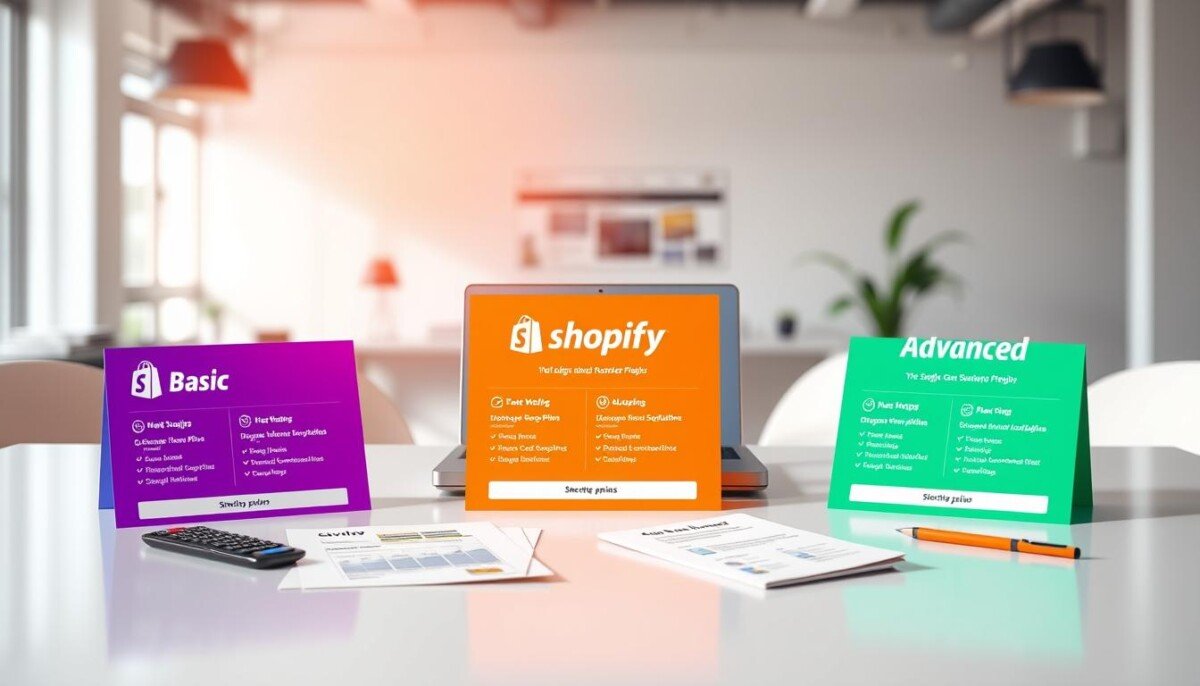
Which tier will let your store grow without wasting money? The right choice depends on your monthly sales, team size, and whether you sell across borders.
You can start as low as $5 per month or scale to an enterprise level that runs thousands per month. Choosing well saves real cash: merchants who pay yearly cut subscription costs by about 25%.
Every tier covers hosting and core features, but advanced tools like real-time carrier shipping and custom reports sit behind higher levels. Use Shopify Payments to avoid extra third-party transaction fees and lower your card rates on sales.
We will walk you through cost drivers — base fees, transaction fees, app costs, and staff accounts — so you can match a plan to your business needs. For a detailed comparison to other platforms, see a clear platform comparison.
Key Takeaways
- Pick a plan based on monthly revenue and team size.
- Annual billing often saves about 25% over month-to-month.
- Shopify Payments can cut third-party transaction costs.
- Higher tiers unlock shipping rates and detailed reports.
- Factor in apps, card rates, and staff accounts when budgeting.
Understanding Shopify Pricing Plans Explained
Plans scale by features and user seats, not just by a monthly sticker price. That means your choice should match how much automation you need and how many staff accounts will access the store.
Every tier charges a subscription per month and may add transaction fees if you use third-party payment gateways. Using shopify payments often cuts those extra charges and lowers credit card rates.
Think in stages: the basic plan supports new stores with core features and lower startup cost. Higher tiers add advanced tools like POS Pro, multi-location inventory, and custom reports that save time as you grow.
Budget for more than the monthly fee. Apps, shipping tools, and extra staff accounts change the total cost per month. Compare features against expected revenue to pick the plan that gives the best value now and room to scale toward shopify plus.
- Tip: Match the plan to team size and sales volume, not just price.
- Tip: Swap to shopify payments to avoid unnecessary gateway fees.
The Starter Tier for Social Selling
For testing merch or one-off items via link-in-bio, the Starter tier offers a no-friction path to sell.
Cost and setup: The plan costs $5 per month and gives a simple checkout link you can share on TikTok, Instagram, or any profile.
What it skips: There is no full online store, so you won’t get custom themes, advanced inventory tools, or POS Pro features.
Be mindful of the 5% transaction fee. That rate can erode margins as your sales grow. If volume rises, upgrade to the basic plan to lower fees and add storefront features.
Use this tier when you want fast payments, low upfront cost, and an easy test channel for a new product.
| Feature | Starter | Basic | Grow |
|---|---|---|---|
| Price | $5 per month | $29 per month | $79 per month |
| Storefront | No full store; checkout link only | Full online store | Full store + advanced tools |
| Transaction rate | 5% transaction fee | Lower credit card rates | Lower card rates + reports |
| Best for | Creators testing sales via social | New stores building an online shop | Growing teams needing automation |
Evaluating the Basic Plan for New Stores
For many solo founders, the Basic option balances cost and core tools to run an online store effectively.
Cost and core features: The basic plan costs $39 per month, or $29 per month when billed annually. It gives a full storefront, editable themes, and 24/7 support so you can launch fast and keep orders flowing.
Ideal Business Size
This plan fits solo operators and early brands doing under $50,000 in monthly sales. You get 10 inventory locations to cut shipping time and lower fulfillment costs. That helps new businesses scale without changing platforms early.
Key Limitations
Admin access is limited: the Basic tier does not include staff accounts, so only the owner can manage the admin panel. If you hire help, you will need a higher-level plan or external workflows.
Card rates are 2.9% + 30¢ per online transaction. That fee structure is standard for this tier, so factor it into margins. The plan also lacks advanced third-party shipping calculators and complex reporting tools.
- Good for: entrepreneurs who want a professional store and simple management.
- Not ideal for: teams that need multiple admin accounts or deep reporting.
Scaling Up with the Grow Plan
When your store needs more hands and smarter tools, the Grow plan is the practical next step. It’s built for merchants who have outgrown single-user workflows and need reliable team access.
The Grow option costs $105 per month, or $79 per month when billed annually. You get five staff accounts so your marketing, fulfillment, and management teams can work in parallel.
Benefits for Growing Teams
- Lower card rates: Online credit card fees drop to 2.7% + 30¢, which improves margins as sales increase.
- Professional reports: Deeper analytics give clearer insight into sales, traffic, and conversion trends.
- Shipping and locations: Advanced shipping tools, plus up to 10 inventory locations and discounts up to 87%, cut fulfillment costs.
- Team collaboration: Five staff accounts reduce bottlenecks tied to the Basic plan’s single admin access.
- Better scale: The plan balances monthly cost and features for growing stores that need reliable Payments, apps, and POS support.
Bottom line: If your business needs multiple admins, deeper data, and meaningful shipping savings, Grow is often the right step before moving to a higher tier like shopify plus.
Advanced Features for High-Volume Brands
High-volume stores demand features that prevent downtime and cut per-transaction costs. The Advanced plan costs $399 per month, or $299 per month when billed annually, and is built for merchants with heavy traffic and complex logistics.
You get 15 staff accounts, which helps you delegate tasks across teams and speed up operations. Third-party calculated shipping rates let you show real-time carrier costs to customers, which matters for global orders and multi-location fulfillment.
- Lower card rates: Credit card fees drop to 2.5% + 30¢, saving you money on high monthly sales.
- Custom reports: Use report builders to spot trends and act fast on margin pressure.
- Higher checkout capacity: The checkout scales for flash sales and seasonal spikes.
| Feature | Advanced | Grow |
|---|---|---|
| Monthly cost | $399 / $299 annual | $105 / $79 annual |
| Staff accounts | 15 | 5 |
| Credit card rate | 2.5% + 30¢ | 2.7% + 30¢ |
When to pick this plan: choose it if your business has outgrown the Grow tier, needs international markets, and must lower fees on high transaction volume. It’s the sensible step before a move to shopify plus for enterprise needs.
Enterprise Capabilities with Shopify Plus

Plus is built for brands that need enterprise-grade controls and the power to scale fast.
Start point: Plus begins at $2,300 per month on a three-year term and adds enterprise-level automation and reliability.
Checkout Customization
Checkout Extensibility lets you tailor the buying flow without forking core code. You can add custom logic, alternative payment flows, or dynamic shipping rules to raise conversion.
B2B Wholesale Features
Native wholesale tools let you manage buyer accounts, price lists, and catalogs inside a single store. That reduces app sprawl and speeds large-order processing for merchants selling to other businesses.
Dedicated Support
Plus includes a Merchant Success Manager who guides migrations, peak-season planning, and performance tuning. You also get access to advanced automation like Shopify Flow and up to ten expansion stores for multi-market operations.
| Capability | Plus | Advanced | Grow |
|---|---|---|---|
| Monthly start | $2,300 (term) | $399 / $299 annual | $105 / $79 annual |
| Staff accounts | Unlimited | 15 | 5 |
| Checkout capacity | 40x standard | High | Moderate |
| Included expansion stores | Up to 10 | — | — |
Breaking Down Transaction Fees and Payment Processing
Transaction fees chew into profit on every order, so you should know how they stack up.
Using Shopify Payments removes the extra 0.5%–2% third-party transaction charge that applies when you route payments through external gateways. That alone can save new merchants noticeable cash in the first few months.
If you don’t use shopify payments, expect an added third-party fee that ranges from 0.6% to 2% depending on your plan. For example, a brand on the basic plan pays a 2% third-party fee on top of whatever the gateway charges.
Credit card rates are separate from these transaction fees and vary by plan. Higher tiers lower card and transaction rates, which helps high-volume merchants keep more of each sale.
- Understand the math: factor both card rates and transaction fees into monthly cost forecasts.
- Consolidate payments: using shopify payments simplifies accounting and usually reduces total fees.
- Upgrade rationale: savings on fees alone can justify moving to a higher plan as sales grow.
In-Store Selling Costs with Shopify POS

If you sell in a physical shop, your point-of-sale choice changes monthly costs and workflows.
POS Lite is included with every plan and fits single-location stores with simple needs.
Upgrading to POS Pro adds advanced retail tools but costs $89 per month per location.
POS Pro gives multi-location inventory, staff roles, and detailed sales reports by employee. These features help you track stock, assign permissions, and measure in-store performance.
Comparing POS Lite and POS Pro
- POS Lite: no extra monthly fee; ideal for one small store.
- POS Pro: $89/month per location; supports stock transfers and BOPIS (buy-online-pick-up-in-store).
- Using shopify payments syncs in-store and online sales for unified reporting.
- Multiple stores raise recurring cost quickly; analyze whether Pro features offset the added fees.
| Feature | POS Lite | POS Pro (per location) |
|---|---|---|
| Monthly cost | Included | $89 |
| Inventory across stores | Limited | Full multi-location tracking |
| Staff roles & reports | Basic | Advanced by employee |
| Best for | Single store, low complexity | Retail chains, high volume |
Note: Shopify Plus merchants receive 20 POS Pro locations at no extra charge. That can cut annual cost dramatically for large retailers.
Hidden Expenses to Budget for Beyond the Subscription
Hidden costs often add up faster than your monthly subscription, and they change how much your store really costs.
Third-party apps are a common surprise. Mid-market brands often spend between $350 and $1,400 per month to add email marketing, loyalty, or advanced checkout features.
Premium themes boost design and conversion. Expect a one-time cost between $100 and $500 for a quality theme that fits your brand.
Implementation for custom work can be very costly. Complex builds may run $70,000–$140,000, so plan that into any major redesign or migration.
Payment processing and extra transaction fees also bite into margins. If you don’t use shopify payments, third-party gateway fees can raise your monthly cost.
Other recurring items include domain registration, maintenance, and optional tools like POS Pro for retail, which adds per-location charges.
- Set aside a contingency fund equal to one to three months of operating costs.
- Audit apps and remove unused ones to cut monthly waste.
- Compare card and gateway fees when estimating true cost per sale.
| Expense | Typical Range | When to Expect |
|---|---|---|
| Third‑party apps | $350 – $1,400 / month | Ongoing as you add features |
| Premium theme | $100 – $500 (one‑time) | At launch or redesign |
| Custom implementation | $70,000 – $140,000 (one‑time) | Major builds or migrations |
| POS Pro / retail tools | +$89 / location / month (typical) | If you run physical stores |
Why Brands Migrate to a Managed Platform

Stability and predictable costs push growing merchants to move from self-hosted setups to managed stores.
Managed platforms handle hosting, security, and updates, so your team spends time on growth, not server patches.
Costs shift from ad hoc developer bills and unexpected downtime to a fixed monthly subscription you can forecast. That change helps CFOs plan cash flow and reduces surprise expenses.
Adopting a hosted option also unlocks a broad ecosystem of apps and features you can add without heavy custom code. Merchants use these integrations to speed campaigns and improve checkout performance.
Many businesses move when their current platform becomes a bottleneck. The result is faster launches, fewer outages, and more focus for staff on marketing and product.
- Cut technical debt: remove server maintenance and redirect budget to acquisition.
- Reliable uptime: handle traffic spikes during peak sales without last‑minute fixes.
- Predictable cost: a steady month‑to‑month fee simplifies forecasts.
| Factor | Self‑Hosted | Managed Platform |
|---|---|---|
| Security & updates | Owner must patch and monitor | Platform handles updates automatically |
| Cost predictability | Variable developer and server fees | Fixed monthly subscription and add‑ons |
| Feature access | Custom builds or plugins required | Wide app marketplace and ready features |
| Time to launch | Weeks to months for complex changes | Days to weeks with existing integrations |
If you want a clearer view of hosted options and how they match business needs, check our guide on e-commerce solutions.
Common Objections to Switching Platforms
Decision makers often worry that moving will mean new monthly bills and extra app fees.
Apps vs custom code: many fear you need lots of apps to match legacy features. In practice, app costs are predictable and usually lower than ongoing developer hours to maintain a monolith.
Loss of control: technical leads worry about infrastructure. This is solvable: robust APIs let you customize behavior and integrate tools without hosting your own stack.
Migration friction: the switch can take a month or more, but the long-term gains—faster releases, fewer outages, and lower operational cost—often outweigh the one‑time effort.
- Transaction fees can be cut by using Shopify Payments and the right plan.
- Staff accounts scale with your team and offer fine-grained permissions.
- App spend is a predictable monthly cost versus unpredictable developer work.
Addressing these points early helps you assess true cost and speed. For a deeper cost comparison, see our shopify pricing guide.
Strategies to Minimize Your Monthly Shopify Costs
A few simple moves—billing yearly, using native payments, and pruning apps—shrink your recurring costs fast.
Pick annual billing to lower your subscription by roughly 25% versus month-to-month. That saves cash each month and gives you room to test marketing or inventory buys.
Use shopify payments whenever you can. It removes the 0.5%–2% third-party transaction fees that eat into margins. Fewer gateway fees mean more profit per sale.
Audit your apps and themes. Remove unused apps, and choose a free theme to cut ongoing costs while keeping a clean, professional store look.
- Consolidate marketing and email tools to one provider to lower monthly bills.
- Consider the Grow plan if you have a small team—lower card rates can offset a higher subscription.
- Manage staff accounts and inventory locations so you only pay for what you use.
| Action | Typical Impact | When to Apply |
|---|---|---|
| Annual billing | ≈25% savings per month | Renewal or new signup |
| Use shopify payments | Eliminate 0.5%–2% third‑party fees | When supported in your country |
| App audit & free theme | Cut $50–$1,000+ / month | Quarterly review |
For tighter inventory workflows, see our guide on inventory management tools. These steps keep monthly costs lower while you grow sales and serve customers better.
Conclusion
Your choice of plan determines how smoothly your store scales and how much you keep from each sale.
Pick a plan that fits your monthly sales and team needs to avoid wasted spend. Consider annual billing and using native payments to cut fees fast.
Decide early whether you need POS Pro and extra staff accounts so you only pay for features that drive value. Whether you start on a basic option or move to an enterprise tier, focus on the tools that speed growth.
For a deeper cost breakdown and a clear comparison, see this concise guide on Shopify pricing to help finalize your choice.