Can a throwaway address really keep your inbox clean and your data private? That’s the question many professionals face when they register on new websites.
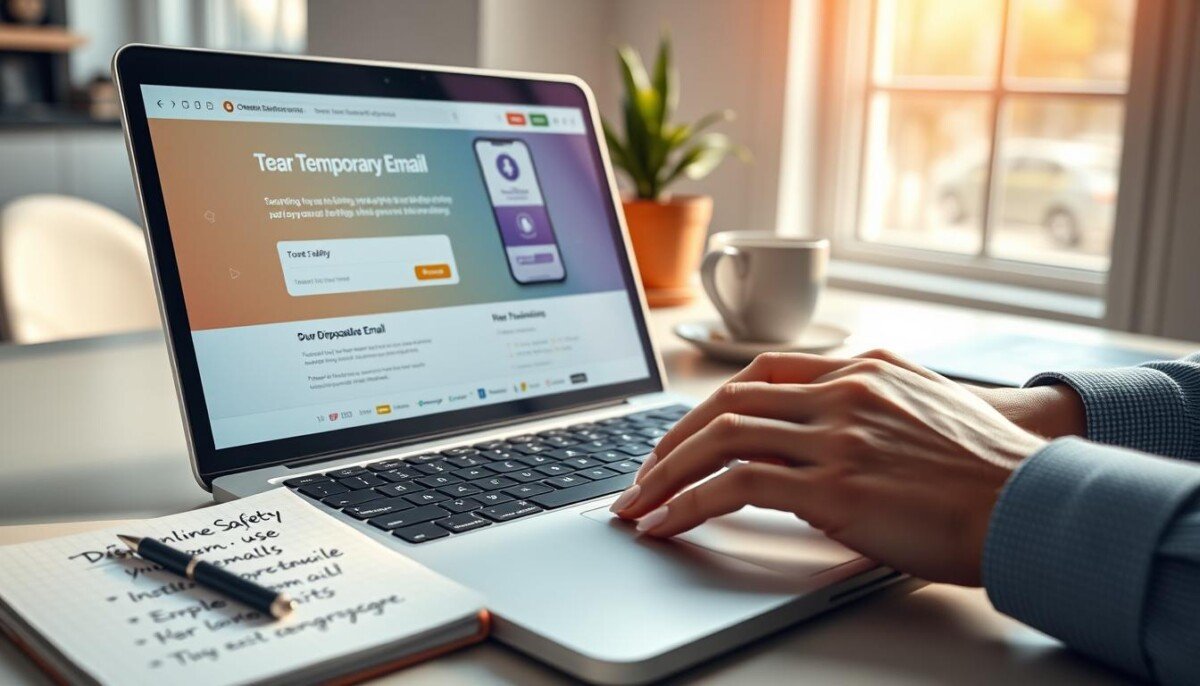
You need quick access to downloads or a trial without handing over your main account. Tools like AdGuard Temp Mail give you a free disposable email address instantly and without creating an account.
Using a disposable email acts as a shield. It stops spam and reduces the chance that your personal information will be shared or sold.
When should you use a temporary email address? Use it for one-off signups, downloads, or when a site looks untrusted. A throwaway address lets you receive messages for a short time and then move on.
This approach helps you manage your online footprint, avoid clutter in your primary inbox, and limit tracking by advertisers. It’s a simple, practical way to protect your data while you work on the web.
Key Takeaways
- Disposable addresses keep your main inbox free of spam.
- AdGuard Temp Mail provides instant, account-free throwaway addresses.
- Use a temporary email address for short-term signups and downloads.
- Throwaway mail helps limit data sharing and advertiser tracking.
- It’s an easy, low-risk way to protect personal information online.
Understanding the Role of Temporary Email Services
A disposable email address acts as a quick buffer between your main inbox and the many websites that ask for contact details.
These solutions store incoming messages on a provider’s server so you can view them in your browser. Most let you get an address without creating an account, which makes the process fast and low friction.
Use a throwaway address to filter out spam and marketing before it hits your primary account. You can also test new web platforms and handle one-off registrations without long‑term clutter.
Key benefits include protection of personal data, short retention times for messages, and less risk of being added to permanent lists. A reliable mail solution helps users keep a clean inbox while still receiving needed verification and messages.
- Buffering: protects your real address during registration.
- Spam reduction: stops unwanted marketing from reaching your main account.
- Controlled lifetime: addresses expire so data isn’t stored long‑term.
For troubleshooting verification that never arrives, see this guide on receiving no login verification email to learn quick fixes and next steps.
Why Privacy Advocates Use Disposable Addresses

Privacy-minded users choose throwaway addresses to protect their main inbox and stay anonymous online. This simple step reduces the risk that your real email address will be harvested by marketers, data brokers, or malicious actors.
Protecting Your Primary Inbox
When you use a disposable email for one-time signups, promotional messages stay away from your primary account. That keeps your inbox focused on work and important updates.
It also lowers the chance that your contact will be sold or leaked after a breach. You get verification or access without exposing long-term information.
Maintaining Online Anonymity
A throwaway address lets you join forums or test web tools without linking activity to your personal accounts. You can interact, receive messages, and then let the address expire.
Use this approach when a site seems untrusted or when you want to avoid tracker networks. For signup errors or account issues, see our guide on sign-up problems.
- Keep your inbox clean: avoid spam and promo clutter.
- Limit exposure: hide your real email address from unknown sites.
- Stay anonymous: interact online without revealing identity.
Evaluating the Safety of Temporary Email Services

Check how an address is stored and who can view it before you use it. A public inbox can expose messages to other users if links are shared or access controls are weak.
Encryption matters. A temp mail provider that does not encrypt messages can leave your data readable on the server. That raises the risk of leaks and phishing.
Risks of Public Inboxes
Many users assume every fake email solution is private. That is not true. Some public inboxes allow others to see incoming messages if they know the address URL.
- Use reputable aliases: AdGuard Mail forwards messages to your real email address without revealing it.
- Avoid sensitive accounts: Do not use a throwaway email for banking, work accounts, or long-term logins.
- Check retention: Pick a provider that deletes data after a set time to reduce exposure.
For more on hardening access and handling delivery issues, see our guide on security and mail problems.
Top Rated Providers for Disposable Communication

Not all throwaway addresses act the same — some focus on privacy while others prioritize speed.
Privacy Focused Options
AdGuard Temp Mail tops many lists with a 4.9/5 rating from over 740 users. Its long track record in privacy—17 years and 160 million users—makes it a strong pick if you value protection.
Speed and Reliability
Need a fast address? 10MinuteMail gives a mail address that lasts 10 minutes, which is ideal to avoid spam and quick verifications.
Multi-Platform Support
ThrowAwayMail keeps messages for 48 hours, giving you more time to receive emails. Yahoo also offers up to three disposable address aliases inside its platform for those who want integrated tools.
- AdGuard: high trust, ad-free, reliable delivery.
- 10MinuteMail: ultra-short lifespan for quick tasks.
- ThrowAwayMail: longer retention for delayed messages.
- Yahoo aliases: built into a mainstream inbox.
| Provider | Key Feature | Best For |
|---|---|---|
| AdGuard Temp Mail | Reputation, ad-free, forwarding | Privacy-minded users |
| 10MinuteMail | 10-minute lifespan | One-off verifications |
| ThrowAwayMail | 48-hour retention | Delayed deliveries |
| Yahoo | Up to 3 disposable aliases | Integrated inbox users |
How to Properly Use a Temporary Email Address
Grab a provider-generated address and paste it into registration forms for one-off tasks.
Copy the address, register, and check the provider inbox to receive verification without giving out your primary contact.
Make sure you check that inbox often. Many providers delete messages and the whole account after a short time.
Do not use a temp address for banking, work, or accounts you must access later. Instead, create a new disposable address for each separate sign-up to keep things isolated.
- Use for downloads and trials to avoid promo clutter in your main inbox.
- Generate fresh addresses when managing multiple accounts.
- Manually delete an address when finished to stop further messages.
If a sign-up shows an occupied contact, follow our guide for resolving email address already in use to fix conflicts quickly.
| Step | Action | Why it matters |
|---|---|---|
| 1 | Copy generated address | Fast setup; no personal contact shared |
| 2 | Check inbox often | Avoid missed verifications |
| 3 | Delete when done | Stops future spam and protects privacy |
Advanced Alternatives for Long Term Privacy
Hosting mail on your domain puts you in charge of addresses, retention, and delivery rules.
This path is for users who need permanent control over their contact points. You run software like Postfix or Exim to send messages and Dovecot to receive them.
Proper DNS setup is critical. Configure MX, SPF, and DKIM records so messages land in the recipient inbox and avoid being flagged as spam.
Self-hosting lets you create unlimited disposable email addresses tied to your domains. You can set lifetimes, custom filters, and unique features that fit your workflow.
Expect a learning curve. Managing a server means handling updates, backups, and security. The trade-off is higher privacy and zero reliance on third-party providers.
Quick comparison
| Component | Role | Recommended Tool | Why it matters |
|---|---|---|---|
| SMTP | Sends outgoing mail | Postfix / Exim | Reliable delivery and control |
| IMAP/POP | Receives and stores mail | Dovecot | Secure access to messages |
| DNS | Delivery & authentication | MX, SPF, DKIM records | Prevents spam flags and spoofing |
| Domain | Owner-controlled addresses | Custom domains | Full privacy and branding |
Conclusion
Use a disposable email address when you need fast verification without exposing your main contact. It stops most spam and keeps your primary inbox focused on work.
Pick a quick temp mail option for one‑time signups, or choose a self‑hosted route if you want long‑term control. Match the features to the task so the tool fits your workflow.
Remember: a disposable email address is best for short use, not for critical accounts. For more on safe setup and troubleshooting, see the temp mail options and this security and mail guidance.
Use the right tool, limit exposure, and keep control over your digital footprint.