Most Apple Watch problems clear with a force restart, a charging check, or a fresh connection to your iPhone. A rechargeable battery’s maximum battery capacity estimates how much charge it holds compared with when new. A frozen screen, missing alerts, or a watch that will not charge can interrupt your day, but the right first check can save time and protect your data.
Many faults affect only one feature, so a full reset may be more work than needed. A quick restart can help with a frozen watch, while power and connection checks point to different causes. Match the fix to the symptom before you erase settings or data. Start with the least disruptive fix that matches the problem you see.
Key Takeaways
- Restart only when the watch is not in an active update.
- Check the charger and battery estimate for power problems.
- Keep your paired iPhone close for pairing and sync checks.
- Erasing a watch does not always remove Activation Lock.
- Check model and iPhone support before installing an update.
- Keep the exact symptom and model ready if you need help.
Troubleshooting Apple Watch: Start With These Checks
If the screen is frozen and the watch will not respond, a force restart is the quickest low-risk test. Use it when the display or controls stop responding, not during an active watchOS update. A restart does not erase data, and it can help separate a temporary software stall from a deeper fault.
Hold the side button and Digital Crown together for at least 10 seconds, until the Apple logo appears. Let go when the logo shows, then give the watch time to start. Do not press buttons to force a restart while watchOS is installing, since the update needs time to finish.
| Symptom | First check | What the result suggests |
|---|---|---|
| Frozen screen | Force restart | Restart clears a temporary stall |
| Watch not responding to touch | Check Water Lock | Water Lock may block taps |
| Several features failing at once | Check paired iPhone connection | Phone or connection may be at fault |
A frozen screen needs a force restart
A frozen screen can make the whole Apple Watch seem broken, even when only one process has stopped. After the logo appears, test the screen and one control you could not use before. If they work, the restart likely cleared a temporary freeze.
If the watch does not restart, note whether the screen stays dark or shows the Apple logo. Those signs point to different problems. A watch that starts but freezes again needs more focused checks than a screen that never lights.
Isolate the watch from an iPhone problem
When several features fail together, check whether the issue follows the watch or the paired iPhone. Keep the iPhone unlocked and near the watch when checking a pairing or sync problem. Then compare a feature that works on the phone with the same feature on the watch.
If an alert appears on the iPhone but not the watch, the phone’s alert settings or connection may explain the gap. If the watch controls also fail when the phone is nearby, the watch may need its own check. This simple comparison helps avoid changing unrelated settings.
Write down the exact failure, such as “screen ignores taps” or “health data stopped syncing.” That note can help you spot a pattern after the restart. If the watch restarts but the same fault returns, record the exact symptom before trying a more disruptive fix.
Fix Apple Watch Charging and Battery Problems
If the charging symbol does not appear, check the charger and its connection before blaming the battery. A dead outlet, loose magnetic charger, or damaged cable can look like a failed battery. Start with the power path, then check battery health if charging works.
Use these five checks before seeking battery service: each one can rule out a common charging problem without changing watch data.
- Check that the wall outlet and power adapter work.
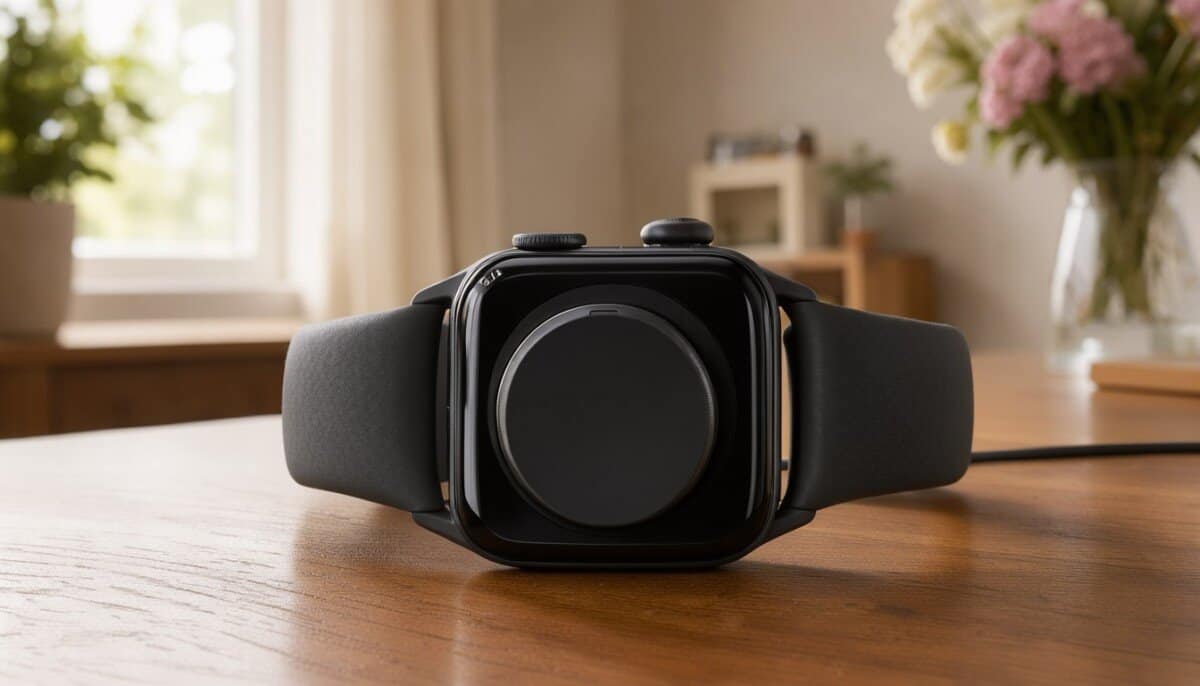
- Seat the magnetic charger against the back of the watch.
- Clean the charger and the watch back with a soft, dry cloth.
- Inspect the cable for cuts, bends, or other visible damage.
- Test another cable or outlet if one is available.
Check the charger before the battery
A magnetic charger can look connected while sitting slightly off center. Move the watch until the magnets hold it flat, then wait for the charging symbol. A different outlet can help tell whether the wall power, adapter, or watch is at fault.
Apple Watch uses a rechargeable lithium-ion battery. Its maximum battery capacity falls as the battery chemically ages, and its lifespan depends partly on charge cycles and care. A lower estimate does not mean the watch has stopped working, but it can help explain shorter use between charges.
Read battery health and care signs
Open Battery Health in the watch settings to review the estimate. Some models can recalibrate maximum battery capacity after a supported software update. Apple Watch Series 4 and Series 5 may recalibrate after watchOS 9.0 or later.
Apple Watch Series 6 (44mm) may recalibrate after watchOS 9.4 or later. Series 7 and Apple Watch SE 2 may do so after watchOS 26 or later. Series 8 and Apple Watch Ultra may do so after watchOS 26.6 or later.
A recalibration can change the estimate without changing the battery itself. A short-term drain change after an update also does not prove battery failure by itself. Let normal use show whether the change lasts before treating one unusual day as a lasting fault.
For long-term storage, leave the watch at about half charge. Avoid extended charging or storage in hot places, including direct sunlight. Keep the watch out of hot places while charging or storing it for a long time.
Fix Apple Watch Pairing and Reset Problems
If the pairing animation stays on screen for several minutes, reset the watch from pairing mode before starting setup again. Keep the paired iPhone close during setup, and try manual pairing if the camera method fails. Choose the reset route carefully, because erasing and unpairing have different effects.
Unpairing through the paired iPhone’s Watch app removes the watch from your iCloud account and removes Activation Lock. Erasing directly on the watch does not do that when the paired iPhone is unavailable. You will still need the Apple Account and password used to set up the watch.
Pair or unpair with the iPhone nearby
Manual pairing is available from the watch’s pairing screen. In the Watch app on iPhone, start pairing and choose the manual option when the camera view does not work. Then follow the on-screen steps to connect the watch.
These four routes cover common setup and passcode problems:
- Use the paired iPhone’s Watch app to unpair and clear the watch.
- Erase from watch settings if the paired iPhone is unavailable; Activation Lock remains.
- Reset on the charger if you forgot the passcode; Activation Lock remains.
- Reset from pairing mode if setup stalls, then start pairing again.
Choose the right erase or reset path
Erasing removes data from the watch, but it does not always remove its link to the Apple Account. That is why an erase without the paired iPhone still needs the account and password used during setup. Do not confuse this route with unpairing through the Watch app.
If setup asks you to restore the watch, use a nearby iPhone or iPad with Wi-Fi and Bluetooth turned on. It can be a friend’s device, and your watch data is not shared with that device. Charge the watch to at least 50%, then place it on its charger during restore.
If restore fails on a 5GHz Wi-Fi network, try a 2.4GHz network instead. Avoid captive networks that require a web sign-in, and avoid 802.1X networks. These network limits can block a restore even when the watch and phone are close.
Before erasing a watch, make sure you know the Apple Account and password that set it up.
Fix Apple Watch Software Update Problems

A watch can install only the watchOS versions its model supports, so check compatibility before retrying an update. Fixing the latest Apple update starts with model and iPhone compatibility, a nearby paired iPhone, and the watch on its charger. Compatibility comes first; an unsupported model cannot install a newer system.
Series 1, Series 2, and Series 3 cannot install current watchOS 27. The supported ranges below show why older models may not see the same update choices as newer watches.
- Series 1 and Series 2 support watchOS 3 through watchOS 6.3.
- Series 3 supports watchOS 4 through watchOS 8.8.1.
- Series 4 and Series 5 support watchOS 5 through watchOS 10.6.1.
- Series 9 and Ultra 2 support watchOS 10 or later; watchOS 11 needs an iPhone XS or later with iOS 18 or later.
- Series 10 supports watchOS 11 or later; updating to watchOS 11 needs an iPhone XS or later with iOS 18 or later.
- watchOS 27 works with SE 3, Series 9 or later, and Ultra 2 or later. It needs iPhone 11 or later, or iPhone SE (2nd generation) or later, with iOS 27.
Check model and iPhone compatibility
The Watch app on iPhone shows update options for a paired watch. Check the model name and the iPhone’s iOS version before trying again. This matters for troubleshooting Apple Watch Series 3, Series 4, or Series 5, since each has an older support range.
Keep the paired iPhone close and the watch on its charger during the update. An update can take several minutes to an hour. A progress bar that moves slowly does not always mean the install has stopped.
Get an update unstuck or installed
If an update will not start, use this short checklist before trying another install:
- Confirm the watch is connected to its charger.
- Restart the watch and the paired iPhone.
- Check that the iPhone is not using a VPN.
- Open the Watch app and retry the update.
If installation fails, open the Watch app on iPhone and go to General, then Storage. Delete the update file there, then download it again. This clears an incomplete file without erasing the watch’s other data.
In watchOS 27, Walkie-Talkie is no longer available on Apple Watch. Its absence is a feature change, not an update failure. Leave the watch on its charger and keep the paired iPhone nearby while the update runs.
Understand Apple Watch Screen, Button, and Symbol Problems
A red dot or a locked screen can be normal behavior, not a broken display. Check the symbol before treating the screen or button as damaged. Some alerts explain the behavior, while a dark screen or failed control may need another check.
Water Lock blocks screen taps until you turn it off with the Digital Crown. The table shows what three common symbols and display symptoms mean, plus the first action to try.
| Symbol or symptom | What it means | What to do |
|---|---|---|
| Water Lock | Screen taps are blocked | Press and hold Digital Crown |
| Red dot | Unread notification | Swipe down on the watch face |
| Workout icon remains after workout | Workout may still show | Restart the watch |
Read status symbols and alerts
A red dot marks an unread notification. Swipe down on the watch face to read it. If the Workout icon remains after a workout ends, restarting the watch is the recommended next check.
Water Lock can be on after water use, so taps may seem broken even though the display works. Press and hold the Digital Crown to turn Water Lock off. Then test the screen again before changing other settings.
Restore touch and button response
A screen that lights but ignores touch is different from a screen that stays dark. Check whether the watch is charging before assuming a dark display has hardware damage. A dead battery can make the screen appear fully broken.
If the Digital Crown feels stuck, clean around it carefully with fresh water and dry the watch. Do not force the crown or push a sharp tool into the gap. If a button stays stuck after cleaning, stop pressing it and seek help.
If the screen stays dark after the watch has had time to charge, treat it as a possible hardware issue.
Restore Apple Watch Notifications and iPhone Connection

If alerts stopped or the watch lost its iPhone connection, check connection and notification modes before resetting anything. Start with the link between devices, then check whether a mode is blocking alerts. This keeps you from changing settings that do not affect the problem.
When the Apple Watch is disconnected, move the devices closer or turn off Airplane Mode. Keep the paired iPhone connected to a network when checking app alerts and sync. The table lists the first check for three common states.
| State | What you may notice | Check |
|---|---|---|
| iPhone disconnected | Watch shows no phone connection | Move devices closer together |
| Airplane Mode on | Wireless connection is off | Turn Airplane Mode off |
| Do Not Disturb on | Calls and alerts stay quiet | Check the active mode |
Reconnect a watch that is out of range
Move the watch and iPhone closer together if the watch still shows a lost connection. Check that Airplane Mode is off on the watch and phone. Also confirm the paired iPhone can reach the internet or its mobile network.
For more general wireless tips, see this guide to Bluetooth connection problems. Its steps cover headphones, not Apple Watch pairing, but can help with other devices that drop a Bluetooth link.
Check notification modes and app alerts
Do Not Disturb stops calls and alerts from ringing or lighting the screen, but alarms still sound. Check the active mode if several kinds of alerts stopped at once. For a single app, open the Watch app on iPhone and tap Notifications.
Choose the app and check whether its alert setting allows notices on the watch. Also confirm the paired iPhone itself can receive a connection and show that app’s alert. For help with a particular service, see these Facebook birthday alert fixes.
After changing the setting, recheck one alert from an app you expect to notify you.
Fix Apple Watch Apps, Performance, and Activity Tracking
If one app fails while the rest of the watch works, update or reinstall that app before resetting the device. Check for updates in the watch App Store, then remove and reinstall an app that still crashes. Fix the app first, not the whole watch.
Check available storage when an app or update cannot complete. Low free space can stop an install even when the app itself is working. Remove items you no longer need, then try the install again.
Repair an app that crashes or will not update
Open the App Store on the watch and check the app’s update page. If the app still closes or fails to load, delete it and install it again. Save any app-only details you need before removing it, since that app may keep its own data.
Some newer models manage performance when battery conditions may affect response. This applies to Apple Watch Series 5 and later, Apple Watch SE and later, and Apple Watch Ultra and later. A slow response can reflect that management rather than a fault in one app.
Improve slow response and activity tracking
Activity readings depend on a snug fit and a clean sensor surface. Wrist Detection also depends on a secure fit, so tighten the band enough to keep the watch in place. Wipe the sensor area clean before testing again.
On iPhone, check Fitness Tracking in the Watch app settings. You can also review fitness calibration settings there if distance or movement readings seem off. For troubleshooting Apple Watch Series 1 activity issues, start with a restart, fit, and tracking settings.
Check whether activity tracking improves after the watch is fitted securely and the tracking setting is enabled.
Know When Battery Service or Repair Makes Sense
If the watch still fails after basic checks, service is the next step when the issue points to a worn battery or hardware fault. A practical rule of thumb is about 3-5 years of useful service, though battery condition and software support affect that span.
Typical out-of-warranty battery service for supported Apple Watch models cost about $99 as of September 2025. Vintage or obsolete models may not be serviceable. The service estimate depends on the model, coverage, and fault, so check the exact option before approving repair.
Apple’s Limited Warranty covers manufacturing issues for one year from purchase. It does not cover accidental damage or a battery worn through normal use. A paid repair may make sense when a device cannot hold enough charge for your daily needs.
AppleCare covers a battery replacement at no extra charge if capacity drops below 80%. This benefit is separate from the one-year Limited Warranty. Coverage terms can change the repair cost, so check which plan applies to your watch.
Apple guarantees repair service and replacement parts for 90 days or the remaining Apple warranty term, whichever is longer. That guarantee applies to the repair, not every issue that may appear later. Ask what the estimate covers before authorizing work.
Check the watch’s coverage and model eligibility before agreeing to a paid repair.
Conclusion
You can solve many watch problems faster by matching the fix to the symptom and avoiding a reset until simpler checks fail. If the issue clears, use the watch normally and watch for the same fault. If it returns, keep the exact symptom, model, and update version ready.
A clear record helps support staff avoid repeating checks you already tried. Try the relevant check once more, then contact Apple Support with your model and the steps you already tried if the fault remains.