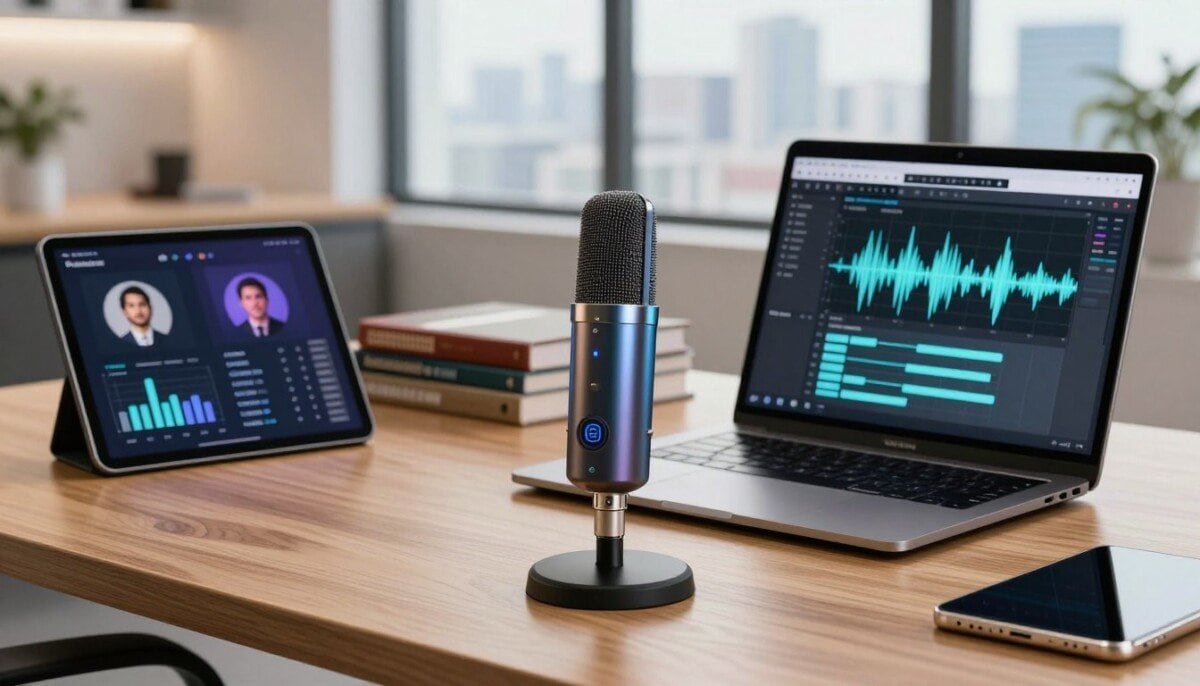
Can a short audio sample and a smart platform replace hours spent recording narration? We ask this because the right approach can free creators from long studio sessions and let us focus on storytelling.
We explore how modern platforms convert text into natural-sounding audio and how a service like FineVoice can clone your voice in one minute from just 30 seconds of input.
Our goal is simple: help you choose a dependable solution that keeps production time low and output quality high. We look at how each option handles speech fidelity, the number of characters and minutes you can generate, and pricing plans so you can match a platform to your project needs.
Whether you need consistent voiceovers for training videos or varied characters for narration, we show how to use these systems to scale production without losing natural tone.
Key Takeaways
- We compare top platforms to save production time and keep audio quality high.
- FineVoice and similar services can clone a sample quickly from short recordings.
- Check limits on characters and minutes to match your content output needs.
- Evaluate pricing plans and platform features before committing to a workflow.
- Good text-to-speech conversion keeps narration natural and engaging.
Why Modern Content Creators Need Voice Cloning Tools
Scaling content means finding reliable ways to produce consistent audio quickly. We want workflows that cut recording time and keep quality high.
Consistency matters. By using voice cloning we keep the same persona across training modules, social posts, and long-form video. This builds trust and saves hours in the studio.
Speed matters too. We can update a script and generate new speech in seconds. That rapid iteration helps teams test messaging and publish more often without bottlenecks.
There are clear productivity gains. Creators who adopt these approaches report faster turnarounds and improved output quality. Integrating high-quality speech synthesis gives audiences a polished experience at scale.
- Maintain brand tone across formats
- Iterate scripts and produce new audio rapidly
- Improve efficiency for training and promotional video
Our Rigorous Testing Methodology for AI Audio
We created a controlled workflow that let us measure audio fidelity, training time, and output limits across providers.
Selection Criteria
We picked platforms that offer cloning from short samples and public model versions such as ElevenLabs v3 alpha.
Key evaluation points: fidelity to original tone, handling of pauses, accuracy on complex words, and free plan limits for characters and minutes.
Testing Workflow
We ran the same script through every service to keep comparisons fair. Each run used a 30–60 second sample when required.
- Process the sample and note training time in seconds and total time to generate output.
- Listen for natural rhythm, pauses, and mispronounced words.
- Use a pro audio editor to measure waveform similarity and confirm the match to the original sample.
- Record free plan restrictions: characters and minutes available per account.
| Platform | Sample Needed | Free Plan Minutes | Notes on Fidelity & Time |
|---|---|---|---|
| ElevenLabs v3 alpha | 30 sec | 5 min | High fidelity; fast training; excellent handling of pauses. |
| MiniMax | 45 sec | 3 min | Warm tone replication; longer processing for complex words. |
| Uberduck | 30–60 sec | 10 min | Good variety of voices; consistent output across versions. |
Top Tier Performers for Professional Results
When quality matters most, we focus on platforms that deliver studio-grade narration with minimal fuss.
MiniMax and Uberduck rose to the top in our tests for consistent, production-ready output.
MiniMax uses the advanced speech-02-hd model to produce clear, natural audio that needs very little postwork.
Uberduck adds a dedicated dashboard to manage ground-truth references, which helps keep any cloned voice consistent across episodes.
Both platforms streamline training so you can move from a short sample to completed audio in minutes. That makes them ideal for training and long-form video where fidelity and turnaround matter.
- MiniMax: studio-grade model, excellent audio quality, low edit time.
- Uberduck: reference dashboard, reliable matched output, easy management.
- Best for projects needing repeatable results and flexible plan options.
| Platform | Model / Feature | Best Use |
|---|---|---|
| MiniMax | speech-02-hd — high fidelity | Professional narration, low edit work |
| Uberduck | Reference dashboard — ground-truth management | Series production, consistent episodes |
| Both | Fast training & short sample support | Training video and long-form content |
Mid-Range Options for Versatile Video Projects

Mid-range platforms strike a sweet spot between cost and audio fidelity for everyday video work.
These services let us generate consistent narration without the highest fees. They integrate with our editing workflow so we can send text and get ready-to-use speech for training, tutorials, and short-series video.
We evaluated each option for clarity, natural pauses, and pronunciation on complex terms. Most mid-tier offerings deliver professional enough quality for educational content and internal training.
- Flexible plans: scale minutes and characters as production grows.
- Reliable output: maintain the same voices across episodes.
- Workflow fit: export formats that drop into common editors with minimal postwork.
| Category | Best for | Typical strength |
|---|---|---|
| Mid-range | Training & educational video | Good balance of price and output quality |
| Scaling plan | Series production | Flexible minutes & character limits |
Evaluating the Best Voice Cloning Tools for Specific Use Cases
Not every platform fits every project, so we match features to use cases. Below we highlight how different needs change our choice of service.
Audiobook Narration
Pick a service built for long-form text. It must keep a steady rhythm and handle chapters without drift. We look for models that preserve tone and accept long script files and many characters in a single run.
Social Media Clips
Speed and clarity matter here. For short clips we prefer platforms that generate a cloned voice fast and export ready-to-use audio for editors. Quick sample-to-clip time keeps content timely and engaging.
Real-Time Voice Agents
Live agents need low latency and stable synthesis. We test platforms for seconds of response time and consistent pronunciation on complex words. This ensures natural interaction in video calls and live demos.
| Use Case | Key Requirement | Best Feature |
|---|---|---|
| Audiobooks | Long-form consistency | Batch script upload, chapter markers |
| Social Clips | Fast turnaround | Quick sample training, instant export |
| Real-Time Agents | Low latency | Streaming synthesis, minimal delay |
Understanding the Technical Requirements for High-Quality Output
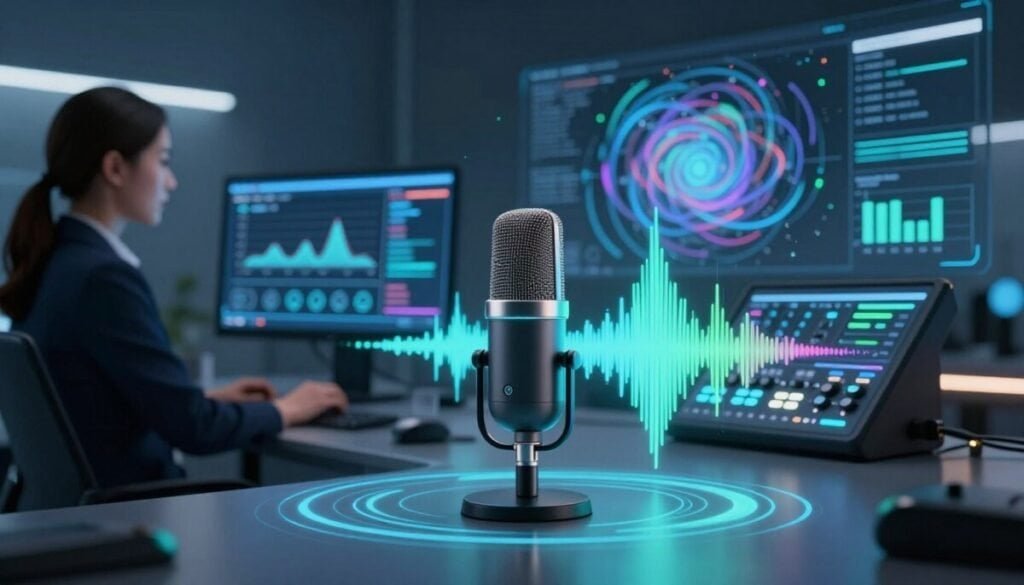
High-quality output starts with the right technical setup before you hit generate. A clear, clean sample is the single most important input the model uses to learn a voice cloning profile.
Use a professional-grade microphone and record in a quiet room. A good mic reduces hiss and room echo and improves the final audio quality for every video.
File format and length matter. Platforms often require specific file types and minimum sample lengths to process correctly. Check those limits before you upload.
- Prefer lossless formats (WAV or FLAC) when possible.
- Confirm minimum sample seconds and any maximum character counts for a single run.
- Plan your minutes and processing time in your subscription plan to avoid interruptions.
| Requirement | Why it matters | Action |
|---|---|---|
| Clean sample | Model fidelity | Record in quiet space with a pro mic |
| File format | Compatibility | Use WAV/FLAC per platform spec |
| Plan limits | Production continuity | Reserve characters and processing time in advance |
Follow platform guidelines to avoid common issues like background noise or distortion. When we prepare samples this way, our speech output matches the original more closely and our videos need less postwork.
Navigating the Ethical Landscape of Synthetic Speech
Respect and consent are the cornerstones of any responsible speech synthesis workflow. We must protect people and their recordings before we start any project that generates audio from a sample.
Privacy and Consent Best Practices
Obtain explicit permission. Always get clear consent from the owner of the sample before you clone or use their speaking style.
Protect stored data. Choose platforms with transparent policies on how they store, encrypt, and purge uploaded audio and generated output.
- Be upfront with your audience when synthetic speech appears in a video.
- Verify the origin of any sample and avoid material that could harm or mislead.
- Keep a documented consent record and retention plan for each project.
| Best Practice | Why it Matters | Action |
|---|---|---|
| Explicit consent | Protects rights and reputation | Signed permission, scope, and duration |
| Data handling | Prevents misuse of samples | Use encrypted storage and clear retention rules |
| Transparency | Builds audience trust | Label synthetic segments in published media |
How to Prepare Your Audio Samples for Better Training
A short, well-recorded clip can make the difference between an odd result and a natural-sounding output.
Start with the right length. Most platforms ask for 30 seconds to a few minutes. FineVoice can create a 1 minute clone from 30 seconds. PlayHT needs at least 30 seconds. Vocloner prefers about 25 seconds, while BookFab’s AudioBook Cloud Enhancer asks for 3–5 minutes for the best fidelity.
Keep the file clean. Record in a quiet room and use WAV or FLAC when possible. Background noise and echo reduce training quality and hurt output on every platform.
Maintain consistent tone and pace across the sample. Use a script that includes varied words, natural pauses, and different sentence lengths. This helps the model learn intonation and phrasing so the cloned voice works across video and long-form narration.
- Record 30 sec–5 min depending on your plan and platform.
- Use a clear script with diverse words and pauses.
- Prefer lossless files and minimal background noise.
Before you upload, review the file. Remove clicks, normalize levels, and check that the recording matches the intended tone. These small steps improve training and lead to higher-quality output with fewer edits.
For a detailed primer on sample prep and ethical steps, see our guide on how to clone a voice and a quick checklist for post-production in podcast editing and distribution.
Comparing Subscription Plans and Free Trial Limitations
Subscription limits and trial rules often dictate how smoothly a project moves from draft to final export. We must match a plan to the scope of our work so we do not hit unexpected paywalls mid-project.
Key factors to check: minutes and characters per month, whether you can download generated audio, and if you can upload audio for a custom voice clone.
Many platforms offer a free trial, but restrictions vary. For example, Descript provides a trial that supports custom voice clones and includes 5 minutes of speech-to-text.
- Download rights: Some trials let you preview output only inside the app.
- Usage caps: Trials often limit characters, minutes, and the length of a sample you can upload audio from.
- Advanced features: Pro models, bulk export, or batch script runs may require a paid plan.
| What to Compare | Why It Matters | Action |
|---|---|---|
| Minutes & characters | Controls how much audio you can produce | Estimate monthly needs before choosing a plan |
| Upload audio / custom clone | Enables branded narration and consistent voices | Confirm trial supports uploads or requires payment |
| Download/export rules | Determines if output is usable in your editor | Test export on the free tier before committing |
By understanding plan limits and trial quirks up front, we choose a service that fits our budget and keeps production moving. For a deeper comparison of service options, see our side-by-side guide at comparing AI voice cloning services.
Common Pitfalls When Generating AI Voiceovers
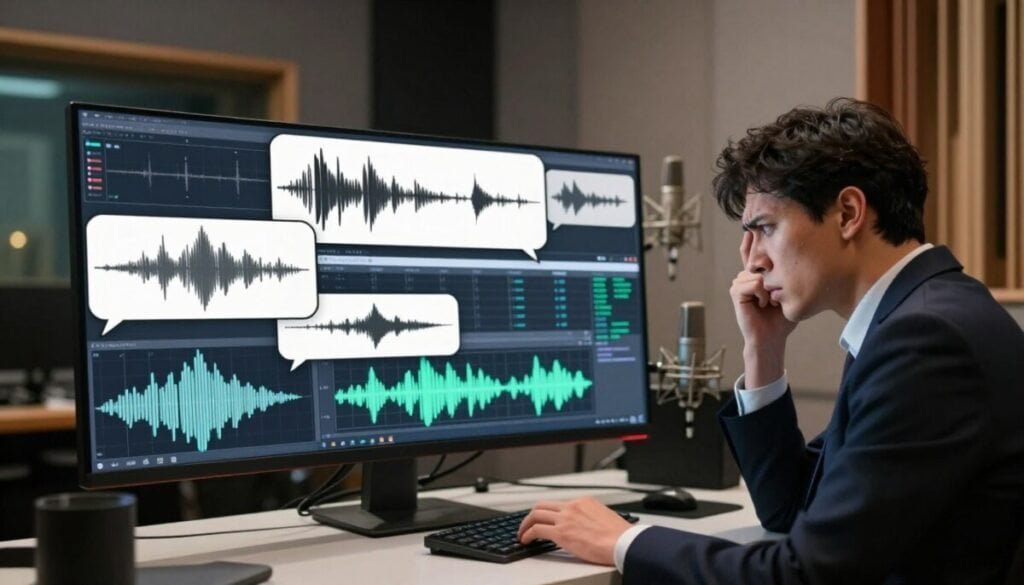
AI narration can sound polished — or it can give your audience a robot-like delivery. We see the difference when small errors slip into a clip. Catching those early saves time and keeps the final output natural.
Dealing with Robotic Intonation
Robotic intonation is the quickest way to lose engagement. Short, monotone lines or awkward emphasis make a clip feel artificial.
To fix this, adjust the text to add deliberate pauses and rhythms. Use punctuation, line breaks, or SSML if the service supports it.
Managing Pronunciation Errors
Complex words and names often trip synthesis engines. We test difficult terms early and build a pronunciation guide in our editor.
Practical steps:
- Run short tests for tricky words and tune phonetic spellings.
- Use an editor to correct misreads or add custom pronunciations.
- Review each clip to confirm audio quality before final export.
| Issue | Likely Cause | Quick Action |
|---|---|---|
| Flat tone | Missing pauses or emotion | Add punctuation and breaks |
| Mispronounced words | No pronunciation hint | Use phonetic spelling in text |
| Uneven rhythm | Long sentences | Split lines; test short clips |
We prefer a service that offers features to tweak tone and emotion. A good voice cloning software helps refine rhythm, pauses, and stress so the cloned voice fits the project plan.
Final Recommendations for Your Next Audio Project
, Choose a solution that matches your project scope, budget, and turnaround expectations.
We recommend a platform that balances speed with fidelity. Our top-tier performers deliver the most reliable results for professional training and long-form video.
Prepare clean samples and test short scripts to tune pauses and tone. A well-made clip helps the cloned voice sound natural and cuts edit time.
Follow ethical best practices: secure consent and protect stored material. When we use these systems responsibly, the results support clear, engaging speech for every project.
Final tip: pick a plan that fits monthly minutes and export needs so your next audio project ships on time and at high quality.