Can a single digital system turn chaotic lines into smooth customer journeys?
We believe it can. Modern businesses use digital tools to manage high-traffic events and product launches with clarity and speed.
In 2026, restaurants and event teams are rethinking how they control guest flow. A robust system lets us send timely updates so every customer knows where they stand.
Our analysis focuses on the best options that streamline operations and cut admin time. We tested tools that integrate with your website or app and enhance the guest experience.
Ready to pick the right setup for your launch? Read on to see how the right choice saves staff hours and keeps customers happy.
Key Takeaways
- Digital tools help manage guest flow for launches and events.
- A good system reduces staff time on admin tasks.
- Restaurants benefit from precise customer updates.
- Integration with your website or app boosts the guest experience.
- Choosing the best option prevents technical hiccups during high traffic.
Why Modern Businesses Need Reliable Waitlist Software
Peak periods demand a dependable system that keeps customers moving and staff focused.
Modern businesses rely on efficient management to give every customer a positive experience during busy hours and product drops. Digital tools reduce crowding in stores and venues, so guests feel safer and teams stay calm.
A reliable system sends real-time updates to customers, cutting uncertainty and no-shows. Restaurants that adopt a dedicated app report smoother service and better staff morale, which improves table turnover and guest satisfaction.
Implementing these tools also unlocks analytics on visitor volume and peak times. Those insights help us make data-driven decisions about staffing and inventory, which supports growth and preserves a professional image.
- Real-time alerts: keep customers informed.
- Reduced crowding: safer, cleaner spaces.
- Operational insights: informed scheduling and planning.
| Benefit | What it fixes | Impact |
|---|---|---|
| Real-time updates | Customer uncertainty | Higher satisfaction and fewer no-shows |
| Crowd control | Overcrowding at peak times | Safer environment, better service flow |
| Analytics | Unknown peak patterns | Smarter staffing and inventory decisions |
| Automation | Manual errors and long admin tasks | Lower workload, improved staff morale |
For teams ready to move from pen-and-paper to a modern approach, we recommend reviewing CRM and customer tools to ensure tight integration. See our guide on customer relationship management for options that pair well with a digital queue system.
Essential Criteria for Evaluating Your Management System

Choosing the right management system starts with clear criteria we can test and measure.
Key Features to Look For
We focus on features that reduce friction for staff and guests. Automated SMS notifications and real-time alerts are a must. They keep every user informed and cut no-shows.
Robust analytics let us track service times, visitor trends, and queue performance. That data helps optimize shifts and improve throughput.
User-friendly interfaces shorten training time. A clear dashboard should let staff update the queue quickly without technical help.
Compatibility and Integration Needs
Compatibility with POS and CRM systems matters. Seamless integration reduces duplicate entry and manual syncing.
- Look for flexible integration options to scale with your business.
- Confirm APIs or native connectors for your key tools.
- Verify industry-specific features for retail or hospitality use.
We also test how easily a tool connects to existing systems. Smooth integration minimizes setup time and preserves daily operations.
For teams evaluating broader management stacks, see our guide on choosing project management software for tips on matching integrations and workflows.
Top Picks for Restaurant and Hospitality Operations
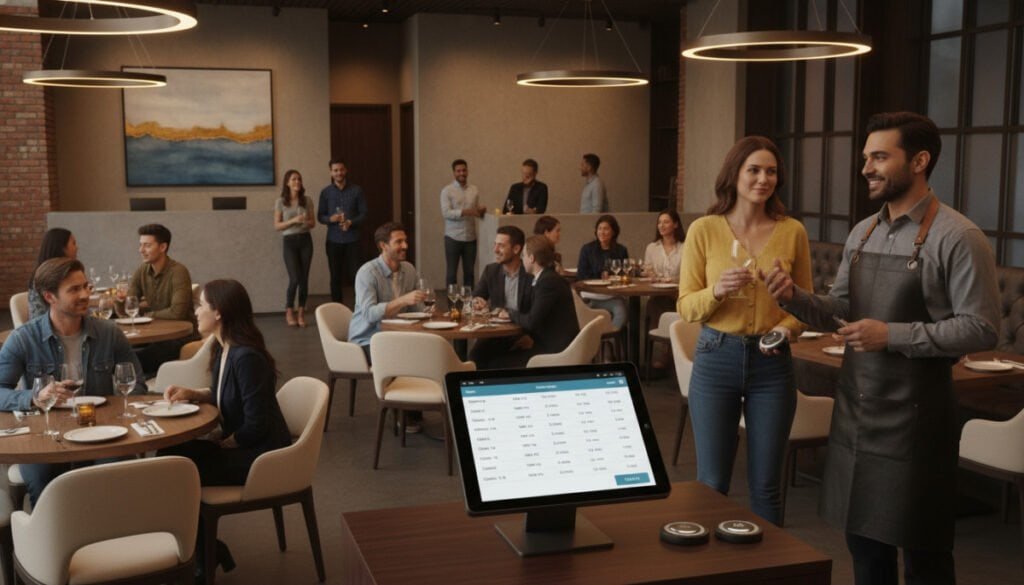
Choosing the right front‑of‑house platform saves time and keeps guests satisfied on busy nights.
Eat App for All-in-One Management
Eat App is a full restaurant management platform that starts at $0/month with a 14-day free trial. We liked the site and social media widget that lets guests join the waitlist from any device.
It scores well on reviews (4.2/5 on Capterra) and includes messaging, table management, and integration options.
Yelp Guest Manager for Local Visibility
Yelp Guest Manager puts local discovery at the front. Pricing begins around $249/month and it bundles an integrated queue and profile marketing tools.
This choice helps restaurants attract nearby customers and manage peak flows directly through their Yelp listing.
OpenTable for Full-Service Needs
OpenTable is geared to full-service restaurants handling high guest volumes. Its Core plan runs about $299/month and offers advanced table and guest management tools.
We found it strong on analytics and table rotation, which improves service and sales on busy nights.
| Tool | Starting Price / Month | Notable Feature |
|---|---|---|
| Eat App | $0 / 14-day free trial | Website widget, SMS messaging |
| Yelp Guest Manager | $249 | Local visibility, integrated queue |
| OpenTable | $299 | Advanced table management |
- Virtual waiting room features help keep guests engaged during peak shifts.
- Pick a management system that integrates with your POS to track every table turn.
Best Solutions for SaaS Founders and Digital Product Launches

For indie teams, the right signup flow turns curiosity into measurable momentum.
Waitlister for Indie Hackers
We recommend Waitlister as a lightweight platform that helps founders validate ideas fast. The free plan covers 100 subscribers and requires no credit card. That lowers friction for early signups.
The $15/month plan scales to unlimited growth, adds email broadcasts, and removes branding from the widget. Waitlister has processed over 2.5 million signups and 700,000 referrals, proving its referral and growth features work at scale.
- Key features: AI landing page builder, referral programs, virtual waiting room, analytics and integrations.
- Why it works: founders can test demand, manage a launch queue, and grow users without upfront costs.
| Plan | What it includes | Best for |
|---|---|---|
| Free | 100 subscribers, no credit card | Idea validation |
| $15/month | Unlimited, email broadcasts, branding removed | Small teams |
| Enterprise | Custom integrations, support, advanced analytics | High-growth launches |
Versatile Platforms for Multi-Industry Queue Management
Across industries, flexible queue tools help teams keep lines moving and customers calm.
Qminder is a strong example of a multi-industry platform. It combines strict data protection — HIPAA and GDPR compliant — with an interface staff learn quickly.
Key features include a virtual waiting room, iPad or QR check-in, and real-time analytics that show peak hours and staff load. Many government offices, healthcare centers, restaurants, and retail locations use it to cut waiting times.
Integration options let the system talk to your existing tools. That keeps customer records accurate and reduces double entry.
- Multi-location support for chains and franchises
- Detailed reporting to improve table and staff allocation
- Compliance and security for sensitive environments
| Use Case | Starting Price / Month | Notable Advantage |
|---|---|---|
| Healthcare | $429 | HIPAA compliance, patient check-in |
| Government | $429 | Scalable queue management |
| Retail & Restaurants | $429 | Multi-location reporting, guest flow |
For a deeper comparison of options tuned for retail and store fronts, see our review of the best queue management systems for retail.
Comparing Pricing Models and Subscription Plans
Choosing a plan is more than price; it’s about fit for your launch window.
Understanding Free Tiers and Trials
We always test a free trial before committing. A good free trial lets us try core features without a credit card. Some tools ask for payment details up front; others offer a permanent free plan for small teams.
Tip: confirm whether advanced integration or messaging tools are gated behind higher tiers. That saves surprises later and keeps your guest experience consistent.
The Value of One-Time Pricing
Many businesses prefer a one-time model to avoid monthly fees. LaunchList, for example, offers one-time pricing from $19 to $299. That works well for founders who want a clear, single cost for a short launch or event.
We recommend matching the plan to your expected users and required features. Transparent pricing and simple tiers let you pay only for what you need.
| Plan type | Cost | Best for | Notes |
|---|---|---|---|
| Permanent free | $0 | Small teams, testing | Limited features, no credit card |
| Monthly subscription | $15–$299 / month | Growing restaurants, ongoing use | Scales with users; integrations often in higher tiers |
| One-time purchase | $19–$299 | Founders, short launches | Single payment; avoids monthly billing |
For deeper reads on pricing structures and funnels, see our guide to SaaS pricing models and the Autofunnel guide.
Integrating Your New Tool with Existing Tech Stacks
Connecting a new queue platform to your existing stack is the step that turns features into daily wins.
We recommend starting with the core integrations: POS, CRM, and email marketing. When those sync, guest records stay accurate and messaging hits the right inbox at the right time.
Choose a management system that offers an open API and native connectors. That lets developers map fields, push analytics, and automate table status without manual exports.
A virtual waiting room that syncs with your calendar reduces manual scheduling. It also automates reminders and frees staff from one-off calls.
- Test integrations during a free trial to confirm data flows correctly.
- Verify messaging and widget behavior across desktop and mobile.
- Ensure the platform updates table status in real time for front‑of‑house teams.
| Integration | Key Benefit | What to test |
|---|---|---|
| POS | Accurate table & sales tracking | Order mapping and table close events |
| CRM | Unified guest profiles | Contact sync and visit history |
| Email/Marketing | Targeted campaigns | Subscription flag and message deliverability |
Effective integration keeps waitlist data fresh, improves the guest experience, and separates top-tier tools from standalone options. We test each plan end-to-end so your teams get reliable support when it matters most.
Final Thoughts on Selecting the Right System for Your Growth
Picking the right queue tool shapes how customers feel from first tap to final table turn.
Choosing the best waitlist software is a strategic move that lifts guest satisfaction and boosts sales. Start by mapping your needs—restaurants, launches, and events each demand different features.
Test a free plan or trial to vet messaging, virtual waiting, and integration with your management system. Look for a tool that scales with your business and gives clear data to improve every guest experience.
In short, pick a plan that matches your operations, protects the table flow, and helps you build lasting relationships with customers.