Can a single app turn a pile of paper into searchable, editable files in minutes?
You juggle invoices, contracts, and archived records. Finding the right solution can cut hours from your workflow.
This article guides you through choosing practical ocr software that converts images and pdfs into clear text. We compare options that handle file size, image quality, and batch extraction so you can pick what fits your routine.
Whether you need one quick scan or regular batch processing, the right app helps users keep documents organized and searchable. Expect clear comparisons and business-focused advice to make a fast, confident decision.
Key Takeaways
- Learn which solutions speed document-to-text conversion for busy professionals.
- See how software handles image quality, file size, and multi-page pdfs.
- Find the best workflow for single scans and large batch extraction.
- Understand practical limits so you pick a reliable option for business use.
- Save time and keep documents searchable and accessible.
Understanding the Role of Optical Character Recognition
Every printed page hides searchable information unless it is converted.
Optical character recognition turns scanned paper into usable text that your team can search and edit. This technology reads printed words and maps them into digital form so you can find facts fast.
For businesses, the payoff is clear: reliable ocr software cuts manual entry, improves access to documents, and makes archives searchable. Good systems handle many fonts and layouts, so mixed documents stay accurate.
When you add the right ocr tools, each document becomes a dynamic file that supports collaboration. Teams can annotate, search, and extract data without rifling through boxes of paper.
Below are the core benefits to consider:
- Searchable text from scanned pages
- Faster data retrieval across document sets
- Reduced manual work and fewer transcription errors
Evaluating the Best Free OCR Tools for Multilingual Documents
Handling Arabic, Hindi, or Chinese pages demands targeted recognition models.
Start by testing real files. Try multi-page pdfs and scanned forms that match your daily work. Look for consistent text output across pages and clear handling of layout and columns.
FastOCR for RTL Scripts
FastOCR stands out for right-to-left scripts like Arabic and Urdu. It supports over 25 languages and keeps accuracy high on complex character shapes.
Comparing Language Support
When you compare options, check models that specialize in non-Latin writing. The interface must let users switch languages and apply the right model fast.
- Verify trial features so you can test accuracy on real documents.
- Assess processing time and how the software handles multi-page documents.
- Pick solutions that extract information reliably from scanned pages and fillable forms.
Leveraging Google Drive for Text Extraction
If you keep documents in the cloud, Google Drive lets you convert scans into searchable text without extra installs.
Quick conversion. Upload a pdf or image, right-click the file, and choose Open with > Google Docs. The built-in ocr software will process the file and paste editable text into a new document.
The process handles most simple pages fast. It extracts text from receipts, letters, and single-column reports in seconds.
Where it shines and where it falls short. This method avoids installing extra software and fits teams that already store documents in Drive. It is ideal for quick text extraction on the go.
Limitations include loss of complex layout, mixed columns, and precise formatting. For heavy batch work or advanced data capture, desktop options may suit you better.
- No install needed — works inside Drive.
- Fast for single pages and common file types.
- May not preserve multi-column layouts or exact formatting.
| Use Case | Speed | Layout Preservation |
|---|---|---|
| Single receipt or letter | Seconds | Good |
| Multi-column report | Seconds | Poor |
| Batch of scanned pdfs | Moderate | Varies |
| On-the-go phone image | Fast | Acceptable |
If your team already relies on Google Drive for file sharing, this built-in option gives quick access to editable text without added cost or friction. For cloud collaboration best practices, see cloud storage for collaboration.
Desktop Solutions for English Language Processing
Desktop apps often give the fastest path to clean, editable text for everyday English documents.
Local software keeps control close. You can process pages fast, handle pdf batches, and avoid upload delays. Many desktop options use the Tesseract engine under the hood to deliver steady results.
Tesseract Based Performance
PDF24 and similar apps use Tesseract for reliable English recognition. This setup handles common fonts and business forms with good accuracy.
The interface is usually simple, so users scan, select language, and run processing without long trials. The software reads images and pdfs and returns readable text you can edit or archive.
- Consistent handling of standard pages and forms.
- Low setup effort and predictable processing time.
- Works well for routine document digitization tasks.
| Option | Engine | Strength |
|---|---|---|
| PDF24 | Tesseract | Reliable English text on forms and pages |
| Tesseract-based apps | Tesseract | Consistent performance; fast batch processing |
| Desktop scanners with OCR | Tesseract / Proprietary | Simple interface; good for regular workflows |
Enterprise Grade Document Capture Platforms
High-volume document workflows require systems that automate extraction and classification.
Enterprise platforms scale intake and reduce manual work. The global ocr market is projected to reach $13.12 billion by 2026, driven by demand for capture platforms that handle thousands of pages daily.
Automated data extraction pulls key fields from complex forms and converts them into structured output. This speeds review and feeds your existing business software without extra steps.
Automated Data Extraction
These systems parse mixed pdfs and images to capture invoice totals, names, dates, and other fields. AI models learn document layouts so text extraction improves with use.
Structured Output Benefits
Structured output makes each document searchable and ready for ERP or DMS imports. Teams find records faster and reduce errors from manual entry.
AI Driven Model Training
AI-driven model training tunes recognition for specific forms and page types. Over time the ocr software needs less human correction and supports high-volume processing.
- Scales to thousands of pages per day.
- Integrates with back-office software for faster workflows.
- Optimizes every document for search and archiving.
| Capability | Benefit | Typical Use |
|---|---|---|
| Automated extraction | Fewer manual keystrokes | Invoices, forms |
| AI model training | Higher accuracy over time | Custom document types |
| Structured output | Seamless integration | ERP/DMS imports |
Mobile Scanning Apps for On the Go Productivity
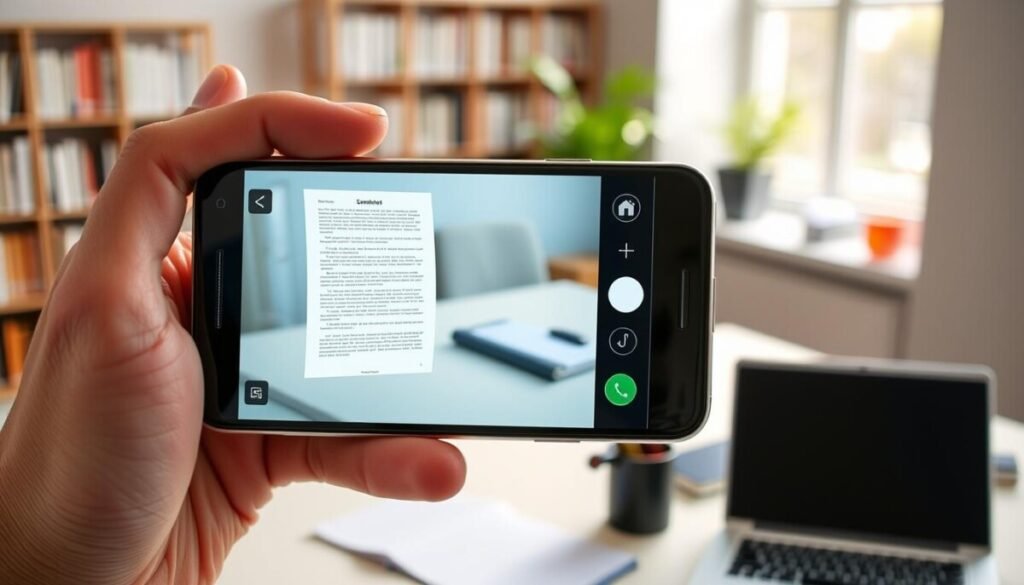
Your phone becomes a portable scanner that turns paper into searchable files in minutes.
Adobe Scan is a leading mobile app that lets users scan up to 25 pages, making it ideal for quick capture while traveling.
Mobile ocr options capture text from receipts, forms, and images. They let you digitize a document and sync files to your cloud or business software in a few taps.
The interface is built for speed. You point, tap, and the software processes each image to extract high-quality text, even under poor lighting.
- Supports receipts, business cards, multi-page reports, and forms.
- Processing happens on the phone so you can act before you reach a desk.
- Consistent support for common file formats keeps files ready for review.
| Feature | Use Case | Speed |
|---|---|---|
| Multi-page scanning | Meeting notes, reports | Fast |
| Auto image clean-up | Receipts, photos | Immediate |
| Cloud sync | Team access to files | Near real-time |
For users who need to manage documents on the move, these apps mirror many desktop features. They keep your workflow moving and reduce delays in handling important pages.
Accuracy Factors in Modern Character Recognition
Clear input delivers reliable output.
Image clarity is the single biggest factor that decides whether character recognition returns clean text or a mess. If a page is cropped, blurred, or low resolution, even strong software will struggle to read characters. Improve scans and you improve results immediately.
Impact of Image Quality
Resolution and contrast matter. High dpi scans make characters distinct and reduce misreads during extraction. Dark or faded ink, skewed pages, and low contrast force models to guess letters and slow processing time.
| Input Condition | Expected Results | When to Use |
|---|---|---|
| 300+ dpi, high contrast | High accuracy, fast processing | Legal docs, pdf archives |
| Low dpi or blurred | Lower accuracy, manual fixes | Phone snaps, quick scans |
| Faded ink or stains | Mixed results; model-dependent | Historic forms, receipts |
Modern models and ocr software can correct some defects and boost character recognition. Still, you get the best accuracy when you optimize images before processing. That simple step saves time and keeps your documents searchable.
Handling Right to Left Scripts in Digital Documents
Right-to-left scripts require software that understands reading order, not just glyph shapes.
Choose ocr software that preserves flow. Languages like Arabic and Hebrew depend on correct line direction and joined characters. If the app treats each glyph in isolation, the final text will lose meaning.
Many common converters fail on these documents. They misplace punctuation, reverse words, or drop character joins. That makes manual fixes slow and risky for record accuracy.
Google Drive can surprise you here. Its engine handles some right-to-left layouts better than basic apps, so test a sample pdf or scan first.
- Verify reading order and punctuation after extraction.
- Test with a real document from your workflow.
- Prefer software that lists RTL language support explicitly.
Character recognition quality matters for business records. Accurate text keeps search, compliance, and downstream systems reliable. Spend a few minutes validating results before you batch-process important files.
Privacy Considerations for Uploaded Files
Before you upload a scanned contract, consider how the service stores and shares your data.
Privacy is a core risk when you send documents to an online ocr service. Many sites process files on third-party servers, so review how long files are kept and who can access the text.
i2OCR is one example that deletes files after processing. That policy reduces the chance of long-term exposure for sensitive files.
If compliance matters, choose local software instead of a cloud app. Local processing keeps the document on your machines and cuts external access.
Look for a clear interface message about retention times and data handling. Users should see how long their files remain and whether copies are stored for analytics.
| Risk | What to Check | Example | Recommended Action |
|---|---|---|---|
| Long retention | File deletion policy | Server keeps files 30 days | Pick services that auto-delete |
| Unauthorized access | Who can view text | Third-party review for improvement | Choose strict access controls |
| Compliance gaps | Local processing option | HIPAA or finance rules | Use on-premise software |
| Hidden reuse | Privacy policy details | Data used for training models | Reject services that reuse text |
Protecting files matters as much as extraction quality. Our analysis includes data handling so you can pick ocr software that balances accuracy with safety.
Comparing Cloud Based Versus Local Processing
Deciding where to process your scans changes how fast and how safe your documents become.
Cloud options like Google Drive let you run ocr from any device with an internet link. This makes setup quick and sharing simple for teams that need fast access.
Cloud services often handle varied pdf sizes and can scale when users upload many files. They may also offer APIs such as OCR.space that support high-volume extraction for developers building document apps.
Local software keeps every document on your machine. That matters when file size is large or when privacy rules require on-premise processing.
Local setups usually give richer features for complex workflows and faster processing for big batches. They need more setup but reduce the risk of sending sensitive text outside your network.
Choose cloud when ease and remote access matter. Choose local when control, security, and heavy processing are top priorities.
- Cloud: quick setup, easy sharing, remote access.
- Local: data stays on-site, handles large files, stronger control.
- API options: scale processing for developers and integrations.
| Aspect | Cloud Processing | Local Processing |
|---|---|---|
| Setup | Minimal; sign in and upload | Install software; configure |
| Security | Depends on provider policies | Controlled by your IT |
| Handling large pdf / file size | May have upload limits or delays | Handles big batches locally |
| Speed for high-volume extraction | Scales but can hit network bottlenecks | Faster for on-premise batch processing |
| Best fit | Remote teams, simple workflows | Regulated industries, heavy-duty users |
Overcoming Common Challenges with Scanned Files
Scanned pages often arrive with faint ink and crooked lines that confuse automated readers.
Small fixes up front give much better extraction results. Prepare the file and choose software features that repair contrast and alignment before you run a pass.
Dealing with Faded Ink
Faded ink lowers character recognition performance and drives up manual cleanup time.
Use apps that boost contrast, apply unsharp masking, or run an auto-enhance step. These features make letters clearer and improve text accuracy on the page.
Correcting Misaligned Text
Even a slight tilt can break line detection and scramble words. Always run a deskew or auto-rotate pass.
DocuClipper ranks fifth for ease of use and includes alignment fixes that cut correction time. Pick software that shows a preview so you can confirm results before full processing.
- Optimize image size and resolution for stable extraction.
- Run contrast and deskew features to boost character recognition.
- Validate a few pages to check accuracy before batch processing.
When you apply these steps, your documents become cleaner, searchable, and faster to archive. That saves time and keeps teams focused on high-value work.
Best Practices for Preparing Documents for Scanning

Small physical steps—removing staples and smoothing creases—have outsized impact on extraction results.
Start simple. Remove staples, paper clips, and folded corners. Lay pages flat so the scanner or app reads each line without distortion.
Use a clean surface and remove dust. High resolution scans give your ocr software clear information and reduce manual edits later.
- Scan at 300–400 dpi for text-heavy pages and legal files.
- Deskew and crop each image before batch processing.
- Group similar forms and pages to help processing models run consistently.
FineReader PDF is used by 74% of small businesses, which shows the value of professional software when you prepare files for scanning.
Use a short checklist before you start. That saves time and lowers the need for manual corrections after extraction.
For a ready-made plan, follow our document preparation checklist to organize pages, images, and pdf batches.
| Prep Step | Why It Helps | When to Use |
|---|---|---|
| Remove staples and clips | Prevents jams and shadows | Any multi-page stack |
| Scan at 300–400 dpi | Improves character recognition | Contracts, forms, archives |
| Group like pages | Speeds batch processing and lowers errors | Large imports or mixed forms |
| Run deskew/contrast | Reduces manual cleanup of text | Phone photos and imperfect scans |
Integrating OCR into Your Business Workflow
When you route scanned documents into core apps, manual entry drops and response times improve.
Nanonets AI automation serves 34% of Fortune 500 companies, showing how integrating ocr software is a strategic move. Automating text extraction saves hours a week for teams that handle invoices and contracts.
Connect scanned pdfs and images to your accounting or CRM. The app can push fields directly into records so users see data where they work.
Every incoming document can be auto-categorized and stored. That makes search fast and cuts admin overhead as you scale.
- Automate invoice and contract intake.
- Map fields to accounting and CRM systems.
- Review and correct via a simple validation step.
| Step | Action | Outcome |
|---|---|---|
| 1. Connect | Link scanner or upload folder to the app | Files flow automatically |
| 2. Map | Match fields to your software | Structured text extraction |
| 3. Validate | Quick human review | High accuracy, low touch |
Start small, scale fast. Use a clear rollout plan and the right software features to make the transition smooth for your team.
Limitations of Free Versus Paid Software Tiers
Subscription tiers change how many pages you can process and which features you can access. Choose a plan with the right capacity so your workflow does not stall on batch jobs.
Common limits include page caps, pdf size limits, and restricted export formats. These constraints slow teams that run weekly imports or archive large folders.
Paid plans often unlock AI-driven models and higher accuracy for complex layouts. They also add features like bulk processing, field extraction, and priority support.
- Trial periods let you test real files before committing to pricing.
- Watch file size and pages limits when planning batch runs.
- Paid tiers frequently reduce manual checks by improving text accuracy and layout preservation.
| Tier | Limit | When to upgrade |
|---|---|---|
| Entry | Low pages per month; basic features | Light, occasional scans |
| Professional | Higher pages; AI models; batch export | Regular volume and complex pdfs |
| Enterprise | Unlimited pages; custom models; support | High-volume teams and compliance needs |
Decide by needs: compare pricing, test a trial with your documents, and pick the plan that saves time while protecting data and improving accuracy.
Selecting the Right Tool for Your Specific Needs

Match your choice of software to the file types, volume, and languages you process.
Compare features and pricing against real tasks. List the document types, expected pages per month, and essential features like multi-page support and language models. This makes the comparison concrete and fast.
Test a few options. Include cloud services such as Google Drive and a local app to see which interface your users prefer. Trials let you check extraction speed and text accuracy on your actual files.
- Decide if you need advanced models for complex forms or a simple app for basic text capture.
- Confirm language support and how each option handles multi-page pdfs.
- Evaluate support, performance, and pricing before you commit.
| Decision Factor | What to Check | Why it Matters |
|---|---|---|
| Accuracy | Sample scans, model types | Reduces manual fixes |
| Interface | User testing, cloud vs local | Saves time for your team |
| Pricing & Trial | Page limits, trial period | Proves value before spend |
Focus on outcomes. Choose the option that cuts touch time, improves results, and fits your budget. That choice will boost productivity and keep documents searchable.
Conclusion
,
Pick an approach that reduces manual entry and speeds access to critical records.
This article guides you to digitize paper and keep searchable text at hand. Choose an app that fits your volume, languages, and privacy needs.
Balance matters: favor accuracy, simple setup, and features that reduce review time. The right ocr software will cut touch time and improve how your team finds information.
Start with a small pilot, validate results on real files, and scale once your workflow runs smoothly. That step turns paper-heavy work into a faster, more reliable process for everyone.