
Ever wondered if speaking could replace typing and free up your hands while you work?
We invite you to explore how a simple switch in input mode can speed up your ideas and save time every day.
Over 10,000 users already rely on our dictation tools to turn speech into clean text and better responses.
Using your microphone and the app settings, we show how to get access to the best voice mode and optimize transcripts, prompts, and privacy.
Try this feature risk-free—every new user has a 7-day money back guarantee as they test coding, chat, and writing tasks on mobile or web.
Key Takeaways
- Speak to capture thoughts faster than typing and improve productivity.
- We guide you through microphone, app, and settings for a smooth experience.
- Dictation creates structured text, useful for prompts, code, and messages.
- Privacy and transcripts matter; we explain how to manage both.
- Join 10,000+ users and try the feature risk-free for seven days.
Understanding the Power of Voice Interaction
Natural speech turns intent into action, speeding up developer workflows. We see Anthropic adding a new voice mode to Claude Code to support hands-free work for engineers.
The dedicated voice option lets users interact in a way that feels natural and fast. It reduces friction from manual entry and simplifies complex prompt design.
We notice that the claude voice capability bridges human intent and machine execution. Advanced recognition helps the system mirror human-to-human dialogue and improves response accuracy.
- Less manual typing: faster task flow for coding and notes.
- Better prompt quality: fewer edits, clearer intent.
- Broader use: creative and professional workflows gain efficiency.
| Benefit | Impact | Use Case |
|---|---|---|
| Hands-free input | Speeds tasks by up to 2x | Refactoring, notes, quick drafts |
| Improved recognition | Fewer errors | Complex prompts, code snippets |
| Seamless intent mapping | Higher productivity | Design reviews, pair programming |
Why You Should Use a Voice Conversation with Claude
Switching from typing to spoken input can cut drafting time dramatically. We find dictation speeds work by reducing manual typing and letting ideas flow. This saves time and keeps momentum during long sessions.
Speed Benefits
Dictation is proven to be 3x faster than typing. That makes it ideal when we need long-form content or complex prompts fast. Errors drop thanks to high transcription accuracy.
Natural Language Flow
We gain immediate access to a more natural mode of input. Speaking a prompt lets us give richer detail, so responses match intent better.
- 3x faster than typing for long drafts and edits.
- 99% accuracy in 50 languages turns speech into clean text.
- Faster access to detailed prompts improves chat quality.
| Feature | Benefit | Typical Use |
|---|---|---|
| Dictation speed | 3x faster | Long articles, code comments |
| Transcription accuracy | 99% across 50 languages | Multi-language teams, precise text |
| Prompt richness | Higher-quality responses | Complex prompts, detailed chat tasks |
Getting Started with Browser-Based Dictation
Getting started is quick: a browser add-on brings dictation straight into your tabs.
Installing the Extension
First, install the browser extension that enables seamless speech-to-text features inside your web apps. The add-on runs in the background and appears as a simple toolbar button.
Once active, the tool captures our voice input and converts it into accurate text. That content is then sent directly to the chat interface or editor we use. Setup takes only a few clicks and minimal permissions.
We keep your data local: all transcripts stay on your device so no third party can access them. This protects your privacy while letting us enjoy fast dictation for notes, drafts, and quick commands.
| Step | What it does | Privacy |
|---|---|---|
| Install extension | Enables speech capture in browser | Permissions only on device |
| Enable mic | Converts speech to text in real time | Transcripts stored locally |
| Use in apps | Send input to chat or editor | Full user control on device |
Setting Up the Official Desktop Voice Mode
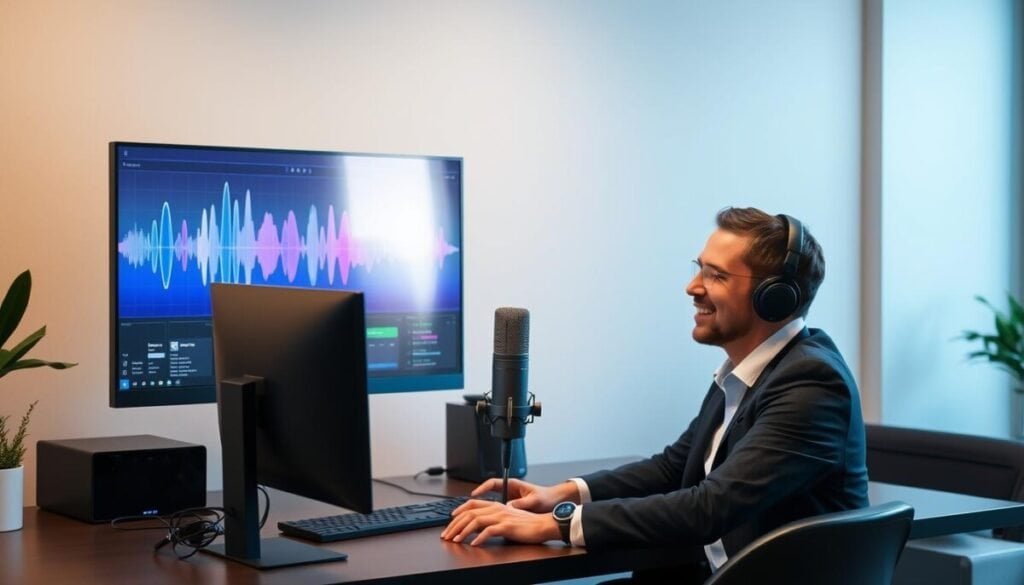
We’ll guide you step-by-step to enable the desktop mode and tune your microphone for clear capture.
Install and open the official app on your desktop. Grant the required permissions when the installer asks. This ensures the app can access your audio devices and system settings.
Next, check your system settings to allow mic access. Adjust the microphone input level so the app hears you without clipping. A clean input improves recognition and reduces repeat prompts.
Inside the app, enable the voice mode option from the main preferences panel. Once configured, we can send spoken input directly to the assistant for a more integrated and stable experience.
- Confirm mic permissions in OS privacy controls.
- Test the input level and reduce background noise.
- Follow the official setup guide for best recognition.
Tip: After setup, run a short test to verify the claude voice path and confirm reliable performance across apps.
Configuring the Model Context Protocol for Audio
Configuring the model layer is a key step to ensure audio flows cleanly between your desktop app and the AI engine.
System Requirements
We must confirm the MCP is supported on our machine. Install the latest desktop client build and verify that audio drivers are up to date.
Ensure your OS grants microphone access and that network ports used by the MCP are open. These checks prevent common connection errors.
Configuration Files
Edit the MCP configuration file to enable the audio adapter and set the correct sample rate. Use our example snippet in the app docs for recommended values.
- Set sample_rate to 48000 for high fidelity.
- Enable the audio_adapter flag to route streams to the model.
- Adjust buffer sizes if you see latency during capture.
Verification Steps
After saving changes, restart the client and run a short test stream. Confirm the logs show an active voice mode session and that the model receives audio frames.
| Requirement | Purpose | Recommended |
|---|---|---|
| Client version | MCP compatibility | Latest stable |
| Sample rate | Audio fidelity | 48000 Hz |
| Buffer size | Latency control | 256–1024 ms |
Tip: This setup is vital for developers who want to use spoken commands to write or refactor code inside the app. Proper MCP configuration unlocks a richer mode of interaction and steadier audio processing.
Comparing Third-Party Extensions and Native Features

We weigh how third-party extensions stack up against built-in tools for fast dictation across our favorite web apps.
Third-party extensions often provide broader compatibility and faster access to dictation across many sites. They let us paste text into Gmail, Google Docs, and other messaging platforms using a single input method.
Native features are improving and offer tighter integration into the app experience. But they can be limited to specific browsers or require an OS-level setup to gain full access.
- Extensions: consistent input across web apps and messages, easy switching on mobile.
- Native tools: deeper integration, lower latency, fewer permissions.
- Our choice depends on whether we want broad compatibility or seamless app integration.
| Option | Strength | Best for |
|---|---|---|
| Third-party extension | Cross-app dictation | Users who work across many web apps |
| Native feature | Deep app integration | Users prioritizing stability and privacy |
| Hybrid approach | Flexibility | Teams switching between desktop and mobile |
For mobile-focused workflows, we often recommend a versatile extension that keeps dictation consistent across apps. If you want an example of a mobile workflow guide, see our schedule tweets guide.
Enhancing Your Coding Workflow with Spoken Commands
Narrating refactors helps us keep momentum when tackling dense logic or long files.
We’ve found that refactoring code via dictation is a game-changer. Developers report it can cut the time spent writing documentation or emails by about 80%.
By using a dedicated mode to issue commands, we keep our hands free and stay in flow. That reduces typing fatigue and speeds edits.
Refactoring Code via Voice
Describe the change you want: rename functions, move blocks, or add tests. The assistant turns clear prompts into suggested diffs and patch-ready text.
- Generate detailed prompts and responses that feel collaborative.
- Keep your hands on the keyboard when needed, or off when drafting large edits.
- Save time by speaking instructions instead of typing every line.
| Action | How it helps | When to use |
|---|---|---|
| Speak refactor intent | Faster design changes, fewer typos | Large files, repetitive edits |
| Ask for test scaffolding | Quicker test creation | Adding unit tests to legacy code |
| Request code comments | Better documentation in less time | Preparing PRs or handoffs |
We encourage you to try this approach on your next project. For workflow tools and automation tips that pair well with dictation, see our guide to the best AI tools for small business automation: top automation tools.
Privacy Considerations for Your Voice Data
When we enable the mode, we make sure transcripts stay on your device and out of external storage.
We prioritize clarity and control. No transcripts or recordings are stored in any database. That means your audio never becomes a shared record.
Our settings let you manage how audio is handled. You can keep raw recordings local, delete past sessions, or disable capture at any time.
By design, the voice path does not use recordings to train models. We do not feed your data into external training pipelines. Your ideas and code remain yours.
- We never store transcripts on our servers or third-party systems.
- Your text and audio are not shared with outside parties.
- Transparency is core: we explain how data stays private and how to change your controls.
Rest assured: our approach keeps interactions confidential and under your control, so you can focus on work without worrying about data leakage.
Troubleshooting Common Audio Connection Issues
Audio problems often hide in plain sight; a few quick checks usually restore a clean connection.
Microphone Permissions
First, confirm the app has access to your microphone in system settings. Open OS privacy controls and allow the application to use the input device.
If the mic still fails, make sure the correct device is selected as the default. Restart the app after changing the selection to ensure the new device is recognized.
MCP Connection Errors
MCP connection errors often come from a misconfigured client or blocked network ports. Restarting the service can clear transient faults.
Check your configuration files for the correct sample rate and audio adapter flags. If latency persists, adjust buffer sizes and retest the dictation path.
- Verify app permissions and default mic selection.
- Restart the MCP service and the desktop client.
- Confirm configuration values (sample_rate, buffer size, adapter flags).
| Issue | Quick Fix | When to Escalate |
|---|---|---|
| Microphone not recognized | Select default input and restart app | Device absent from OS list |
| Permission denied | Grant mic access in privacy settings | Policy blocks permissions in managed devices |
| MCP connection error | Restart service; verify config files | Persistent network or driver failures |
Optimizing Your Prompts for Natural Speech
Framing requests as if talking to a teammate makes prompts easier to interpret and act on. Speak naturally and avoid overly formal phrasing. This simple shift helps the model map intent into clear text.
We recommend a high-quality microphone to keep dictation clean. Clear input reduces errors and speeds up the path from speech to usable prompts. The system handles fast talk and accents with over 99% accuracy, so long, detailed prompts work well.
Adjust your settings to match how you speak. Small tweaks improve recognition and shape better responses. Optimizing speech patterns cuts the need for extra typing and keeps ideas flowing.
- Speak as you would to a colleague for clearer prompts.
- Use a good microphone to reduce edits and improve dictation.
- Lengthy, detailed prompts usually yield stronger responses.
| Action | Why it helps | Tip |
|---|---|---|
| Speak naturally | Reduces ambiguity | Use full sentences |
| Tune settings | Matches speaking style | Test short samples |
| Use quality mic | Cleaner text | Avoid background noise |
Embracing a Hands-Free Future with AI
We are entering a phase where hands-free AI tools let us capture ideas fast and on the fly. That ease turns passing thoughts into usable work.
By adopting this mode, we speed up daily chat sessions and turn spoken prompts into clear text. Dictation helps us keep momentum and save time on repetitive tasks.
As the technology evolves, apps become more efficient and more natural to use. For rollout details and practical examples, see the read the rollout details and our AI tools guide.
Start today: try dictation to capture thoughts, craft a prompt, and send faster chat replies. We think the hands-free path will make your work more creative and productive over time.