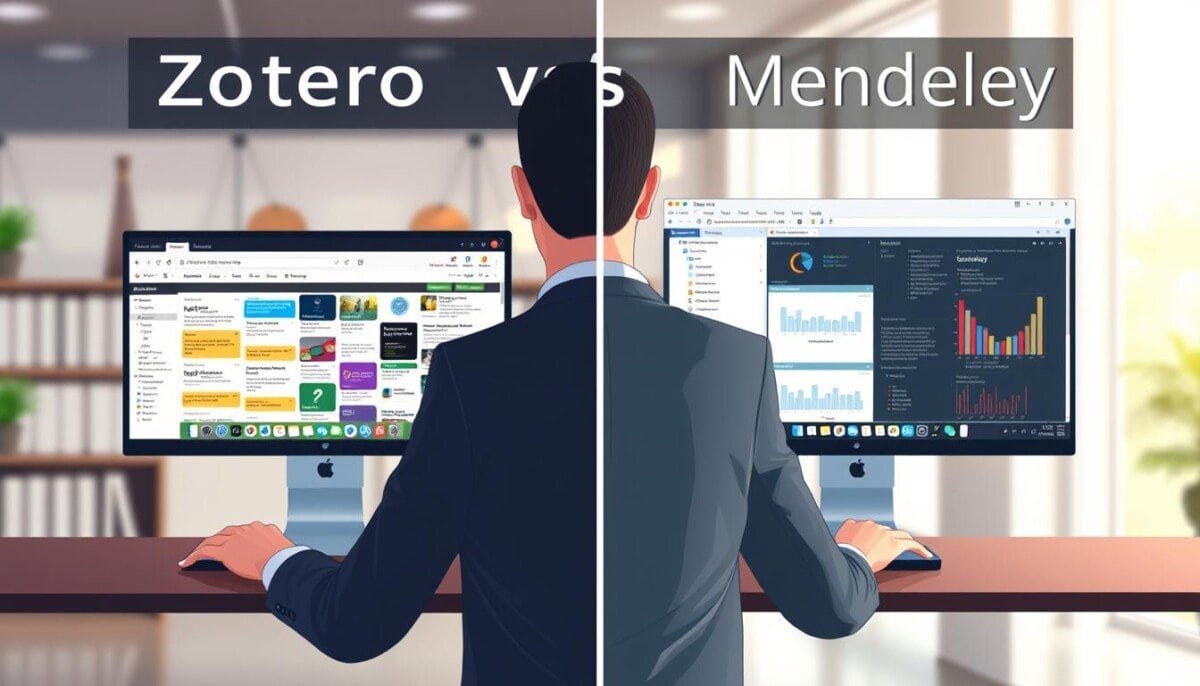
Which reference tool will actually save you time and keep your papers organized for years? Pick the wrong manager and you spend hours fixing metadata, moving PDFs, or wrestling with citation styles.
You need a clear choice for your research workflows. This introduction compares two leading options, their cloud storage offers, desktop support, and how they integrate with tools like google docs.
One option is open source and favors ownership and deep style customization. The other is a cloud-first product backed by a major publisher and gives more free storage for pdfs.
We will show how each manager handles annotations, search, and pricing so you can pick the best reference solution for your writing and library needs.
Key Takeaways
- Choose based on long-term ownership versus cloud-first convenience.
- Check free cloud storage limits if you manage many papers and pdfs.
- Look for reliable desktop support and google docs integration for writing.
- Compare annotation, search, and metadata features for faster workflows.
- Think about citation styles, pricing, and community support before moving your library.
Understanding the Role of Reference Managers
A reliable reference manager is the backbone of efficient research workflows and clean citations. It acts as a central library where you store metadata and PDFs so every paper is just a quick search away.
Good software automates tedious tasks like formatting references and inserting citations into manuscripts. That saves you time when you prepare submissions or revise drafts.
- They let researchers store thousands of papers and manage cloud storage without losing context.
- Strong search and metadata tools keep references discoverable across large libraries.
- Consistent citation management protects the integrity of your work and speeds publication.
Whether you are a student or a senior academic, choosing the right manager shapes your daily workflow. For an overview of complementary tools that support research, see this online research tools guide.
Zotero vs Mendeley: Core Philosophies and Ownership
The way a reference manager is built affects how you control data and get updates.
Open-source flexibility
The open-source project is community driven and backed by a nonprofit. This gives researchers full control over their library and files. You can export data, run local backups, and expect transparent updates.
The commercial product sits inside a larger publisher’s ecosystem. That brings tight integration with publishing tools and extra cloud services. Users gain convenient features and broader integration, but the trade-off can be more restrictive data policies.
- Choose open-source if you want ownership and flexible reference management.
- Choose commercial if you value integrated features, publisher ties, and built-in storage options.
When you compare zotero vs mendeley, think about long-term library control, google docs workflows, and how each approach fits your research and citation needs.
Evaluating User Interface and Accessibility
Your choice of interface shapes how fast you find and cite references during busy research days. A clear layout reduces clicks and saves time when working on manuscripts.
Design matters for everyday use. One manager splits the view into three panes: collections, item lists, and detailed item info. This layout gives power users deep control over a large library.
The other tool uses a modern, streamlined look with a left sidebar that highlights recent or read references. That makes it easier for casual users to jump back into work.
- Power features: advanced tagging and nested collections help manage big projects.
- Ease of use: a clean sidebar keeps core tools within reach for most users.
- Accessibility: keyboard shortcuts and clear labels speed common tasks.
| Interface | Strength | Best for |
|---|---|---|
| Three-pane layout | Detailed control, rich metadata view | Researchers managing large libraries |
| Sidebar-focused UI | Fast access, cleaner daily workflow | Users who prefer simplicity |
| Common features | Tagging, search, citation tools | Both managers for writing and storage |
Comparing Search Capabilities and Library Organization

Powerful search makes large libraries feel small and easy to manage. In busy research workflows, that matters more than fancy UI choices.
Advanced Filtering and Metadata Management
Search depth defines how quickly you locate the exact paper or quote you need.
Zotero offers Quick Search and Advanced Search that scan fields, tags, and the full text of stored PDFs. That lets you pull precise results across an entire library in seconds.
Mendeley provides reliable searches across titles, authors, and years. It works well for smaller libraries, but it cannot search full-text PDFs, so deep digs can take longer.
- Metadata control: full-field queries and custom filters speed systematic reviews and complex projects.
- Organization: both tools support tags, collections, and annotations for scalable library management.
- Choose based on need: pick deep full-text search for large collections or a simpler tool for light libraries.
| Capability | Deep Search | Best use |
|---|---|---|
| Full-text PDF search | Yes (Quick/Advanced Search) | Systematic reviews, large libraries |
| Title/author/year search | Yes | Quick lookups, small libraries |
| Advanced filters & metadata | Granular controls and saved queries | Complex projects and cross-paper synthesis |
Citation Styles and Word Processor Integration
Citation styles and word-processor support decide how smoothly your draft turns into a submission-ready paper.
Zotero supports over 10,000 citation styles through the Citation Style Language (CSL). That wide selection helps researchers working in niche fields match exact journal rules without manual edits.
Mendeley Cite connects cleanly with Microsoft Word and LibreOffice, giving reliable in-document citations for most professional writing. It lacks native Google Docs integration, which can slow collaborative, real-time editing.
- Extensive styles: pick precise formats for journals and theses.
- Word support: insert citations and build bibliographies fast in Word.
- Real-time writing: Google Docs integration favors teams that co-edit live.
- Save time: these reference manager tools remove manual formatting so you focus on content.
Match your choice to the word processor you use most. That ensures smoother citation workflows and fewer edits late in the submission process.
PDF Annotation and Reading Workflows

Good annotation features let you capture insight while you read, so writing goes faster later.
Integrated PDF readers speed daily work. Zotero’s reader supports highlights, sticky notes, image-area selection, and freehand ink markup so you can mark exact passages and add quick thoughts.
Cross-paper synthesis matters when you build themes across studies. Mendeley’s Notebook view gathers highlights from many papers into one workspace, which helps with thematic analysis and systematic reviews.
Annotation flexibility
Both tools sync annotations across devices so your notes stay with the library in the cloud or on desktop. That keeps your quotes and page markers ready when you draft citations or write sections of a paper.
- Zotero-style: flexible markup for freehand notes and color-coded highlights.
- Mendeley-style: centralized notebooks for cross-paper summaries.
- Pick by workflow: choose flexible annotation or structured synthesis based on how you organize literature and write.
For a deeper comparison of features and how they affect your writing, see this zotero vs mendeley guide.
Collaboration and Group Management Features
Shared libraries and clear roles keep group research on schedule. This matters when multiple authors need the same references and PDFs during writing.
Unlimited collaborators in group collections lets large labs add members without extra setup. The manager supports detailed roles and permissions so admins can control edit rights and who adds citations.
Web-based groups make it easy for distributed teams to view and download papers. That cloud access speeds peer review and joint drafts.
- Robust role control: assign admins, editors, or read-only members for tight management.
- Simple sharing: create shared folders of references and pdfs for project teams.
- Public groups: publish bibliographies to the wider research community when needed.
| Feature | Strength | Best for |
|---|---|---|
| Role-based management | Fine-grained access control | Large research labs |
| Web sharing | Easy PDF and reference access | Distributed teams |
| Public groups | Open bibliographies | Community outreach |
Overall, choose the tool whose collaboration feature set matches your team’s size and cloud needs. That ensures smoother citation workflows and fewer lost files during group projects.
Storage Options and Pricing Models

Storage choices shape long-term access and daily convenience for anyone who builds a digital library.
Free tiers differ sharply. One manager lists 300MB as the free quota with paid plans starting at $20/year for 2GB. The other gives 2GB free and monthly premium tiers from $4.99 to $14.99.
For many researchers, free storage dictates early workflow decisions. Students and new users often benefit from the larger free allotment while they grow their library and add pdfs.
Upgrade paths matter. Both products use tiered pricing so you can expand cloud storage as your collection grows. Advanced users can also use WebDAV with the lower-cost option to bypass limits and keep costs down.
- Cost-effective choice: annual plans and WebDAV support lower long-term pricing for heavy library management.
- Generous free tier: helps new users store more references and papers without immediate expense.
- Cloud-first features: higher-priced plans often add AI or sync features that aid citation and search workflows.
Match pricing to your long-term needs. The right reference manager and storage plan will keep files accessible on desktop and cloud while protecting your research budget.
Technical Support and Community Resources
Good support keeps your research moving when issues arise.
Professional support is available through an official help center, email, and live chat. This gives you a clear contact point when desktop syncing, storage, or citation problems block progress. For teams working on time-sensitive papers, prompt response matters.
Community-driven help lives in an active forum where experienced users and staff share fixes, plugins, and workflow tips. That crowd-sourced knowledge often surfaces creative solutions and new integration ideas faster than formal docs.
Both options publish extensive documentation that covers citation styles, annotation workflows, and library management. You can follow guides to set up cloud storage, refine search, and link the manager to your word processor.
- Direct contact: reliable for urgent technical issues and account help.
- Forum and plugins: ideal for customization, community tools, and peer tips.
- Docs and tutorials: step-by-step resources for onboarding and advanced features.
Choose official support if you need guaranteed response times. Choose the forum if you value continuous community development and third-party tools. For a broader comparison of related research tools, see this comparison guide and this tool behavior overview.
Conclusion
Deciding on a reference tool depends on your daily habits and long-term plans. Your workflow, team size, and budget will shape the right choice.
If you prize ownership, customization, and affordable storage for the coming years, the open option often stands out as the best reference for long-term library control and low-cost scaling.
The cloud-first product suits teams that want modern collaboration, AI-assisted reading, and integrated support. Both reference managers have matured into powerful tools that help researchers organize a library and speed writing.
Try both for a short trial period. That practical test will reveal which manager fits your workflows, pricing limits, and support needs before you commit for the year.
Final tip: pick the tool that keeps your references reliable so you can focus on the core of your research.