120Hz vs 60Hz: What High Refresh Rates Cost in Heat and Battery
Published:
Updated:
Disclaimer
As an affiliate, we may earn a commission from qualifying purchases. We get commissions for purchases made through links on this website from Amazon and other third parties.
Can a smoother screen secretly shorten your phone’s workday? This question matters if you rely on your phone for calls, meetings, and quick edits.
High refresh rates promise silky motion on your display, but they can raise power and cpu demands. That higher load often shows up as faster battery drain and more heat during heavy tasks.
Understanding the real difference helps you choose settings that fit a busy schedule. You can tune screen brightness, app refresh, and power modes to get the look you want without losing life or time.
Smoother refresh often increases power use and shortens runtime.
Screen brightness and background apps directly affect drain.
CPU load and heat relate closely to visible performance and life.
Adjusting settings can recover hours of usable time.
Simple steps like lowering brightness help manage heat and preserve cell life.
Understanding Refresh Rates and Display Technology
Refresh rate defines how often your screen redraws each second, and that number changes what you see and how your device performs.
Defining refresh rate
A refresh rate is the count of screen updates per second: 60 updates for the lower standard and 120 updates for the higher setting. The 120 refresh step gives smoother motion for animations and scrolling.
Every update asks the cpu and GPU to render a new frame. That teamwork raises the device’s power draw and can speed up battery drain during heavy use.
Adjusting brightness and the refresh option lets you control how much power the display uses in daily tasks. Limiting the rate reduces load on the cpu and can extend run time on long workdays.
Quick difference: higher refresh = smoother view, more power use.
Practical tip: lower the rate when you need longer runtime or less heat.
Analyzing the 120Hz vs 60Hz Battery Impact
Actual tests make it clear how different refresh settings affect daily runtime.
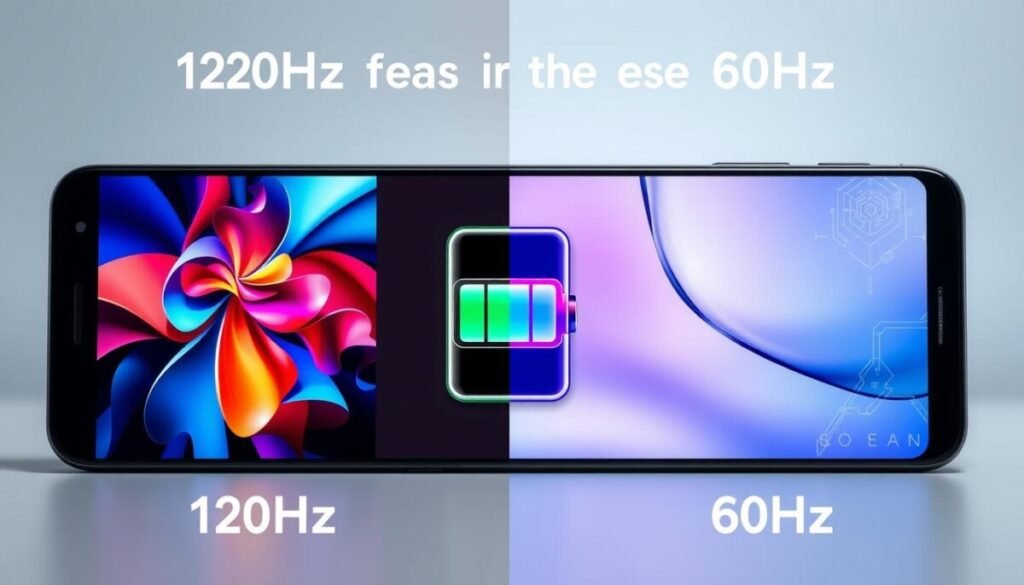
In a real-world run, the faster 120 refresh mode gave a screen-on time of 4 hours and 35 minutes.
The lower 60 setting reached 7 hours and 15 minutes, a near three-hour difference in usable life.
That gap shows the higher refresh rate draws more power and speeds up battery drain.
The constant refresh cycle forces the cpu and GPU to work harder, which raises temperature and power use.
Even at high brightness, the 60 mode runs more efficiently and extends screen time.
Faster refresh = smoother motion but faster drain.
Lower rate = longer runtime when you need it most.
Adjust settings to match your day: choose longevity or smoothness.
If long life matters, pick the lower refresh or use adaptive modes. That choice saves power and keeps your phone working through a long workday.
Real World Performance and Processor Load
Smooth motion looks great, but it also asks more from your phone’s chips.
The Role of GPU and CPU
The GPU and CPU render every frame your display shows. A higher refresh forces both to work harder and longer each second.
That extra work raises power use and speeds battery drain. The phone can feel warmer and run tasks more slowly if heat builds.
Factors Beyond Refresh Rates
Other elements change real world life more than the rate alone. Brightness, background apps, and heavy gaming add load and shorten run time.
For example, using the 120 refresh option during gaming doubles frame work and draws extra cpu cycles. That combination hurts battery life faster than lower settings.
Reduce brightness or limit background processes to save power.
Use adaptive refresh when you need both smooth display and longer time.
Choose lower refresh for long workdays and higher when fluid motion matters.
Conclusion: Balancing Visual Quality and Battery Life
Choose visual smoothness or longer run time based on how you use your phone each day.
Balancing refresh rate and power comes down to your priorities. If you need fluid motion for work or gaming, the 120 refresh rate gives a clear advantage. If long life matters, lower settings save power and reduce drain.
Watch screen brightness and background apps closely. These controls often affect total battery life as much as the refresh rate.
Test both modes during a busy day to find the best trade-off for your workflow. For deeper technical context, see this refresh rate comparison report.
FAQ
What is a refresh rate and why does it matter for my phone?
A refresh rate measures how often the screen redraws each second. Higher rates give smoother motion for scrolling and video, which helps reduce eye strain and makes interactions feel faster. For business users, smoother displays improve perceived responsiveness during presentations and document review.
How much extra power does a high refresh setting consume?
Higher refresh settings draw more power because the display and graphics hardware update more frequently. The extra drain on battery performance varies by phone model, software optimization, and screen brightness, but you can expect a noticeable difference during prolonged use, especially with bright screens or heavy graphics tasks.
Does a faster refresh rate cause the device to heat up?
Yes. When the screen and GPU work harder to meet graphic processing demands, the processor produces extra heat. Heat rises more during gaming or video playback at higher refresh, and sustained temperatures can reduce performance and shorten battery life over time.
Which components contribute most to battery drain at higher refresh rates?
The display performance factors, primarily the display panel and GPU, are the main contributors. The CPU also plays a role when apps push frame rates. Background processes and network activity add to the load, so overall drain depends on the whole system, not just the screen.
Will switching between refresh settings extend my battery life?
Yes. Lowering the refresh rate or using an adaptive mode that drops frames during static content conserves power. For typical office tasks like email and documents, a lower setting delivers a meaningful battery boost with minimal loss of usability.
How much difference will I see in daily runtime when I change refresh rates?
That depends on usage. For light tasks, improvements can be 10–25 percent in runtime. For heavy gaming or extended video, the gap widens because the GPU stays active. Brightness and app behavior also affect real-world savings.
Do brightness and screen type affect power use as much as refresh rate?
Yes. Brightness often has an equal or larger effect on power draw than refresh rate. OLED and LCD panels behave differently: OLEDs turn off pixels for true blacks, which can save energy in some apps, while LCDs keep a backlight on and may show smaller differences.
Are there smart settings to get smooth visuals without sacrificing too much battery?
Use adaptive or variable refresh modes, enable power-saving profiles, and lower brightness. Many phones allow app-specific refresh limits so demanding apps run at higher rates while routine apps stay at lower rates, balancing look and longevity.
Should professionals prioritize smoothness or battery life?
Prioritize based on your workflow. If you present, edit, or demo visuals, smoother motion can matter. If long uptime matters—travel or long meetings—favor lower refresh and other power-saving settings. You can switch modes as your day demands.
Will turning off background apps improve battery life as much as lowering the refresh rate?
It helps, but effects differ. Background apps reduce CPU, network, and sensor use, which saves power across the board. Lowering the refresh rate specifically cuts display and GPU load. Combining both gives the best battery improvement.
Do all phones show the same battery difference between refresh rates?
No. Differences depend on chipset efficiency, display tech, software optimization, and battery capacity. High-end phones often manage power better, narrowing the gap, while older or less optimized models show bigger differences.
Is there any long-term battery harm from using higher refresh rates regularly?
Higher sustained temperatures can accelerate wear, and heavy continuous use shortens charge cycles over years. Occasional high-rate use is fine; continuous maxed-out use may reduce long-term battery health faster than moderate use.
How can I test the best refresh setting for my needs?
Try a week with adaptive or high refresh and track real-world runtime, then repeat with a lower setting. Note device settings such as screen brightness, main apps, and whether you heat the device. This quick A/B approach reveals the best trade-off for your routine.
What settings should I change for maximum battery life without losing too much display quality?
Lower refresh to an adaptive or standard rate, reduce brightness, enable power-saving modes, and limit background app activity. Also check for system updates and app optimizations—software can cut unnecessary frame rendering and improve efficiency.
Marco Ballesteros is a Senior Project Manager, Scrum Master, and SEO Specialist with over a decade of experience leading cross-functional teams and driving digital growth. Currently at Globant, he combines expertise in project management, digital marketing, and agile leadership to deliver innovative solutions. Passionate about teamwork, continuous learning, and helping others succeed, Marco also dedicates his time to volunteering for social impact initiatives.
To provide the best experiences, we use technologies like cookies to store and/or access device information. Consenting to these technologies will allow us to process data such as browsing behavior or unique IDs on this site. Not consenting or withdrawing consent, may adversely affect certain features and functions.
Functional
Always active
The technical storage or access is strictly necessary for the legitimate purpose of enabling the use of a specific service explicitly requested by the subscriber or user, or for the sole purpose of carrying out the transmission of a communication over an electronic communications network.
Preferences
The technical storage or access is necessary for the legitimate purpose of storing preferences that are not requested by the subscriber or user.
Statistics
The technical storage or access that is used exclusively for statistical purposes.The technical storage or access that is used exclusively for anonymous statistical purposes. Without a subpoena, voluntary compliance on the part of your Internet Service Provider, or additional records from a third party, information stored or retrieved for this purpose alone cannot usually be used to identify you.
Marketing
The technical storage or access is required to create user profiles to send advertising, or to track the user on a website or across several websites for similar marketing purposes.