Have you ever wondered why some software solutions come with such varying pricing structures? Understanding the intricacies of software pricing can be a daunting task, especially in today’s fast-paced digital landscape.
As we embark on this journey to explore the complexities of pricing, we aim to uncover how it shapes our modern business environment. The global SaaS market generates approximately $250 billion in annual revenue, a testament to its significance in the industry.
Effective pricing is not just a number; it is the cornerstone of a sustainable and profitable business model. By analyzing various components that influence pricing strategies, we can better align our offerings with customer expectations. Together, we will explore how different models can adapt to meet the evolving needs of users in this competitive market.
Key Takeaways
- Pricing is essential for sustainable business growth.
- Understanding market dynamics can improve pricing strategies.
- Effective pricing aligns with customer expectations.
- Adapting pricing models is crucial in a competitive landscape.
- Comprehensive analysis leads to better decision-making.
Understanding the Landscape of SaaS
The software landscape is evolving rapidly, making it crucial to understand its dynamics. The global SaaS market represents about two-thirds of total public cloud services income, highlighting its massive scale and importance.
We observe that the global SaaS market has become a major pillar of the cloud industry, generating around $250 billion in annual revenue. Our approach involves examining how various saas companies leverage cloud infrastructure to deliver scalable and accessible services to their diverse user base.
We believe that the shift toward subscription-based products is changing the game for how organizations manage their IT solutions and operational expenses. By understanding the broader market trends, we can better position our own offerings to compete effectively against other established saas companies.
Our strategy focuses on how these innovative products provide continuous updates and improvements, which is a significant departure from traditional software delivery methods.
Introducing Our Approach
We are committed to analyzing the trends that shape the market and inform our pricing strategies.
Why SaaS is Changing the Game
Understanding these changes allows us to adapt and thrive in a competitive landscape.
For more insights on project management in small businesses, check out this resource.
Diving into SaaS Cost Dynamics
Navigating the pricing landscape of software solutions requires careful consideration. A recent survey revealed that only 39% of companies in this space adopt a value-based pricing model. This approach is crucial for attracting and retaining customers.
Interestingly, 27% of companies rely solely on their own judgment when setting prices. Additionally, 24% follow their competitors’ pricing models without fully understanding their own value proposition.
Defining the true cost of our service is essential. It ensures that the price reflects the features and value our customers receive. If we fail to align our pricing model with perceived value, we risk losing customers who do not see the benefits of our software.
We aim to move beyond guesswork. By analyzing how specific features contribute to the overall cost and value proposition, we can enhance our offerings and better serve our clients.
Exploring Common Pricing Models
Exploring different pricing options is vital for aligning our offerings with customer needs. There are several models we can consider, each with its unique advantages.
One popular choice is the subscription model. This approach ensures predictable revenue for our business while providing clear access options for our loyal users.
Another effective strategy is tiered pricing. This allows us to offer a range of packages that cater to various user groups, from individuals to large enterprises.
We can also implement usage-based pricing. This model functions like a mobile phone plan, allowing customers to pay only for the specific services they consume.
Lastly, the freemium model encourages users to try our basic features before committing to more advanced paid packages. By experimenting with these different pricing structures, we can determine which options best align with the usage patterns of our target audience.
How Does Our SaaS Pricing Work?
Understanding how we set our pricing is key to our business success. Our approach involves several important steps that ensure we meet the needs of our users while remaining competitive in the market.
First, we conduct a detailed cost analysis. This process involves examining server expenses and software maintenance to ensure our pricing covers all operational needs of the business.
Next, we perform a thorough value assessment. This helps us understand how our service solves specific problems and increases efficiency for our target market.
Through extensive market research, we evaluate what competitors charge. This ensures our pricing remains competitive and attractive to potential customers.
Additionally, we utilize customer data to refine our pricing. This keeps our service relevant as the market and our product continue to evolve.
By maintaining transparency in our pricing, we build trust with our users. This way, they understand the value they receive from our service.
| Step | Description |
|---|---|
| Cost Analysis | Examining server and maintenance expenses. |
| Value Assessment | Understanding service impact on efficiency. |
| Market Research | Evaluating competitor pricing strategies. |
| Data Utilization | Refining pricing based on customer insights. |
| Transparency | Building trust through clear pricing. |
What Sets SaaS Pricing Apart from Others
In the world of software pricing, the focus is shifting towards building lasting relationships with customers. This shift is essential for maximizing long-term value and ensuring recurring revenue.
We prioritize keeping our customers happy over an extended period, which is a core component of our overall growth strategy. Many companies now leverage data-driven insights to adjust their pricing effectively, allowing them to respond to market changes better than traditional firms.
Our recurring revenue model requires us to manage operational costs carefully. This ensures that our pricing strategy remains sustainable for our companies. By fostering long-term customer relationships, we create upsell opportunities that significantly increase the lifetime value of every individual user we serve.
| Focus Area | Description |
|---|---|
| Customer Lifecycle | Maximizing long-term value through relationships. |
| Customer Satisfaction | Prioritizing happiness for growth. |
| Data-Driven Insights | Adjusting pricing based on market response. |
| Operational Management | Ensuring sustainability in pricing strategy. |
| Upsell Opportunities | Increasing lifetime value of users. |
Evaluating Product Value and Customer Needs

Understanding our customers’ needs is essential for developing a product that truly resonates. We recognize that different segments of our audience, such as startups and large enterprises, have unique requirements. By segmenting our target audience, we ensure our product delivers value to both groups.
We also prioritize the specific feature sets that matter most to our customers. This approach helps us justify our pricing and enhances overall user satisfaction. By evaluating which features are frequently used, we can assess the value our product provides in solving daily challenges.
Understanding the diverse needs of our customer base allows us to tailor our offerings effectively. We believe that a successful product aligns its core value proposition with the specific requirements of our most important customers.
| Focus Area | Description |
|---|---|
| Target Audience | Segmenting to understand unique needs. |
| Feature Prioritization | Identifying features that enhance value. |
| Value Assessment | Evaluating usage of product features. |
| Tailored Offerings | Customizing products for diverse customers. |
| Core Value Alignment | Ensuring product meets customer requirements. |
Key Factors Influencing saas cost Decisions
Identifying key factors that shape our pricing strategy is essential for achieving our business goals. Understanding the various costs involved can help us make informed decisions that ensure profitability.
We must account for operational expenses such as hosting, software maintenance, and the hourly rate of our development team. According to Starter Story, the average price to start a software business is $12,272, which includes crucial design and marketing expenses.
Development investments vary significantly. Micro SaaS projects typically range from $10,000 to $25,000, while complex solutions can cost between $150,000 and $500,000.
Our team structure and the complexity of our tech stack play a major role in determining total development costs. We carefully manage our overhead costs to keep our business lean while continuing to invest in necessary product development.
| Cost Type | Average Cost |
|---|---|
| Starting a SaaS Business | $12,272 |
| Micro SaaS Development | $10,000 – $25,000 |
| Complex SaaS Solutions | $150,000 – $500,000 |
| Operational Expenses | Varies by project |
| Development Team Rate | Varies by expertise |
For more insights on financial management software, check out this resource.
Balancing Quality with Our Pricing Strategy

Achieving a balance between quality and pricing is crucial for our business success. We believe that investing in high-quality UI/UX design significantly enhances usability. This ensures our customers perceive the true value of our software.
Moreover, balancing feature complexity with a simple interface is a key part of our approach. This strategy allows us to maintain high quality without overwhelming our users.
We ensure fair value for our customers by aligning our pricing with the outcomes they experience when using our complex software features. Our commitment to quality means we continuously refine our design elements to provide an intuitive experience that justifies our current pricing model.
By focusing on both aesthetic quality and functional complexity, we build a product that our customers are happy to pay for consistently.
- Investing in high-quality UI/UX design enhances usability.
- Balancing feature complexity with a simple interface is essential.
- Aligning pricing with customer outcomes ensures fair value.
- Continuous refinement of design elements justifies pricing.
- Focusing on both quality and complexity builds customer satisfaction.
Adopting Strategic Approaches to Pricing
Crafting a pricing strategy based on real user insights is key to our business growth. We utilize data-driven decision making to inform our pricing strategy, ensuring that every change we make is backed by actual user behavior.
During our discovery process, which costs between $1,600 and $4,800, we gather the data necessary to build a solid foundation for our revenue. This phase typically lasts one to three weeks and is crucial for understanding our market.
Our strategy involves analyzing which features drive the most revenue. This allows us to optimize our pricing over time for maximum financial impact. We believe that a transparent pricing process helps us communicate the value of our service more effectively to our potential customers.
By regularly reviewing our data, we can adapt our pricing strategy to meet the changing demands of the market and our growing user base.
- Data-driven decision making informs our pricing strategy.
- Discovery process costs between $1,600 and $4,800.
- Analyzing revenue-driving features optimizes pricing.
- Transparent pricing helps communicate service value.
- Regular data reviews adapt our pricing strategy.
Implementing Effective SaaS Pricing Tactics
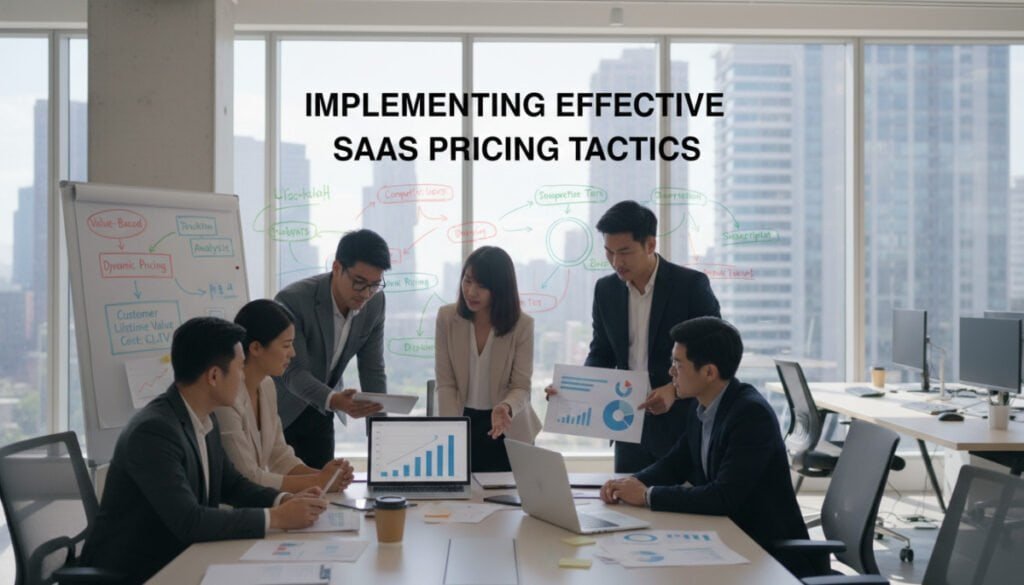
Implementing robust pricing models is essential for sustainable growth in our industry. We begin by launching with a clear strategy that outlines our pricing framework. This helps us manage ongoing marketing expenses effectively, ensuring that we remain competitive.
Our dedicated support team plays a crucial role in maintaining customer satisfaction. The costs for this support can range from $10,000 to $20,000 per month, depending on the scale of the project. This investment ensures that our customers feel valued and supported after their initial purchase.
To stay ahead, we continuously adapt to market trends. Monitoring competitor pricing allows us to adjust our models accordingly, keeping us relevant in a fast-paced software environment. Our marketing efforts are designed to efficiently reach our target audience, helping us manage acquisition expenses while scaling our user base.
We also refine our pricing models based on feedback from our support channels. This approach ensures we always provide the best value to our customers, reinforcing our commitment to their satisfaction.
Final Thoughts on Navigating Our SaaS Cost Journey
Reflecting on our journey, we have gained valuable insights into the pricing strategies that drive our software business. We explored essential components, from initial development expenses to the long-term value we provide to our customers.
By understanding how to balance software quality with a sustainable pricing model, we can ensure our business remains competitive in the global market. Our analysis highlighted the importance of data-driven strategies and the need to adapt our features to meet the evolving needs of our users.
We remain committed to providing excellent support and transparent pricing, which are the foundations of the relationships we build with our customers. As we move forward, we will continue to refine our business processes and marketing strategies to deliver the best possible software solutions to our base.
We are confident that by focusing on value and flexibility, we can navigate the complexities of the software industry and achieve lasting success together. For more information on establishing a professional online presence, visit this resource.